
48V LiFePO4 Solar Battery Guide: Sizing, Charging, and Inverter Matching
A 48V LiFePO4 solar battery can reduce DC current compared with a 12V or 24V bank delivering the same power, which helps make higher-power solar storage practical. The label “48V,” however, may describe either a 48.0 V 15-series LFP architecture or a 51.2 V 16-series architecture. The inverter, BMS, charger, communication protocol, and voltage limits must match the exact battery—not the marketing category alone.
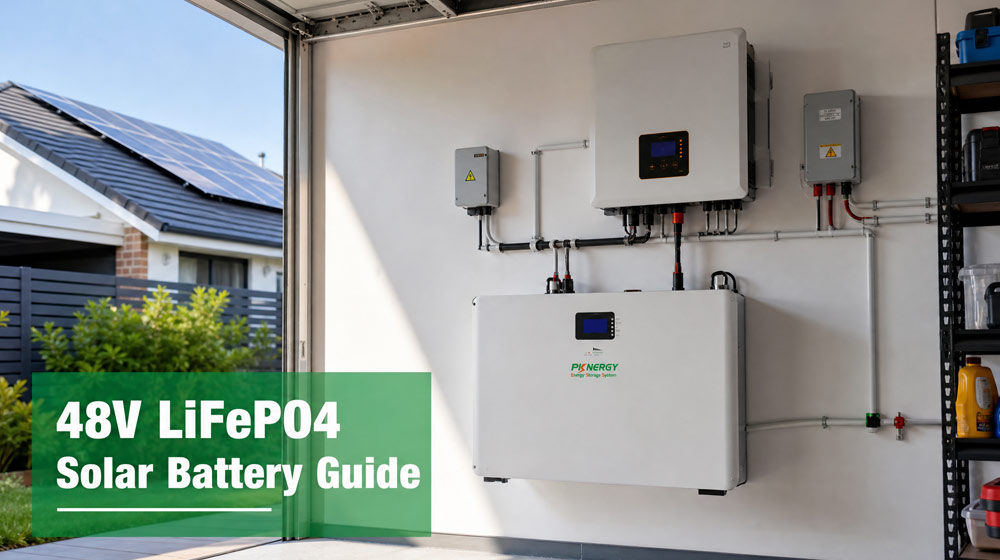
What “48V LiFePO4 Battery” Actually Means
LiFePO4 cells are commonly rated at 3.2 V nominal. Fifteen cells in series create a nominal 48.0 V pack; sixteen cells create a nominal 51.2 V pack. Both can appear in the “48V” product category, but their upper and lower operating voltages differ.
| Architecture | Nominal calculation | Buyer implication |
|---|---|---|
| 15S LiFePO4 | 15 × 3.2 V = 48.0 V | Confirm that inverter firmware and charge limits support the 15S voltage window. |
| 16S LiFePO4 | 16 × 3.2 V = 51.2 V | Common in rack and wall-mounted storage; still requires exact inverter matching. |
| “48V class” equipment | Category, not a full specification | Check minimum DC input, maximum charge voltage, low-voltage cutoff, and restart behavior. |
PKNERGY’s 2024 catalogue lists both 48 V and 51.2 V energy-storage models, illustrating why buyers should quote the complete model and voltage range. Never apply a generic LiFePO4 battery 48V charge setting to a system until the approved datasheet and inverter configuration are aligned.
Size the Solar Battery in Kilowatt-Hours
Begin with a load audit. List each essential load, its operating watts, hours per day, and startup surge. Add the daily watt-hours, decide how many autonomy days or backup hours are required, and account for inverter losses, reserve state of charge, temperature, and aging.
Suppose essential loads consume 4 kWh overnight. If planning with 92% inverter efficiency and an 80% usable design window, the initial nominal requirement is about 5.43 kWh before any additional aging or seasonal margin. This is a planning example, not a product promise.
A 51.2 V, 100 Ah module has 5.12 kWh of nominal energy. A 48 V, 100 Ah module has 4.8 kWh. Amp-hours alone hide this difference, so procurement comparisons should use both nominal and warranted usable energy under defined conditions.
Verify Power and Current, Not Just Energy
A battery may contain enough energy for the night but still be unable to start the largest load. Approximate battery-side current by dividing inverter input power by battery voltage and efficiency. A 5 kW output at 92% efficiency requires about 5.43 kW from the DC side, or roughly 106 A at 51.2 V before considering surge behavior.
Compare that result with the battery’s continuous discharge rating, peak rating and duration, BMS response, terminals, busbars, disconnect, and conductor ampacity. If modules operate in parallel, confirm how current shares between branches and how each branch is fused.
Match the Inverter and BMS Communication
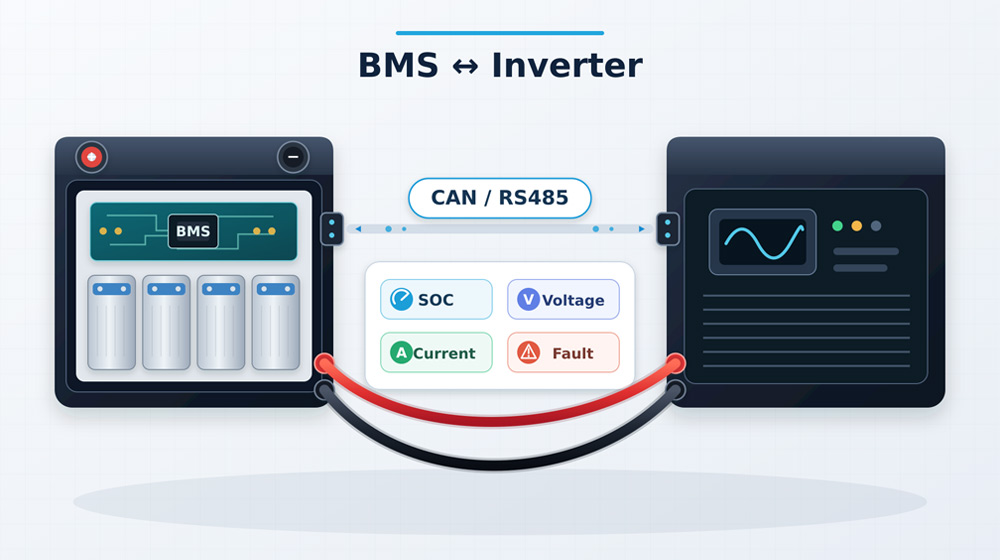
Closed-loop systems exchange state of charge, current limits, voltage, temperature, and fault information through CAN or RS485. Compatibility requires more than matching connector shapes: the battery protocol, inverter brand/model, firmware, port assignment, address settings, and cable pinout must agree.
PKNERGY’s energy-storage catalogue describes CAN, RS232, and RS485 interfaces on applicable models and notes inverter communication support. Buyers should request the current compatibility list for the exact battery firmware and inverter model. If operating open-loop, use only the voltage and current settings approved by both manufacturers and understand which protections remain local to the BMS.
Configure Solar Charging Correctly
The MPPT solar charge controller or hybrid inverter must use the battery manufacturer’s charge voltage, current limit, low-temperature rules, and end-of-charge behavior. Do not copy a voltage from another 48V battery because 15S and 16S LFP systems differ. Also avoid lead-acid equalization and unapproved temperature compensation.
Check the maximum PV input voltage separately from the battery charge voltage. Panel string voltage determines whether the array is safe for the controller input; battery-side current determines whether the charger and battery can accept the available power. Confirm cold-weather PV open-circuit voltage, controller output current, and any power derating.
Sequence and commissioning
Follow the inverter, charge-controller, and battery manuals for connection and startup sequence. During commissioning, verify polarity, open-circuit voltage, grounding scheme, communication, charge current limits, low and high state-of-charge behavior, emergency shutdown, and recovery from protective events.
Plan Parallel Expansion Before Purchase
Parallel modules can increase energy and available current, but expansion must be designed. Ask for the maximum approved module count, master/slave architecture, addressing method, busbar layout, equal cable resistance, branch protection, firmware requirements, and whether new modules can be added to an aged bank.
Use matched modules at a closely aligned state of charge. Mixing capacities, cell configurations, firmware, or battery ages may produce unequal current sharing and inconsistent state-of-charge reporting. For cabinet or rack systems, also verify floor loading, service clearances, ventilation, ingress protection, and fault isolation.
48V LiFePO4 Solar Battery Procurement Checklist
- Exact nominal voltage, series-cell count, total voltage range, and usable energy
- Continuous and peak charge/discharge current with defined durations
- Compatible inverter models, protocols, firmware, cable, and commissioning guide
- Maximum parallel modules and required protection or combiner equipment
- Charge and discharge temperature limits, sensors, and low-temperature behavior
- Cycle-life test conditions, retained-capacity endpoint, and warranty energy assumptions
- Mechanical drawing, IP rating, terminal type, installation method, and service space
- UN38.3 test summary, SDS, shipping configuration, and destination-market documentation
Frequently Asked Questions
Is a 51.2V battery the same as a 48V battery?
It is often sold in the 48V system class, but 51.2 V usually indicates 16 LFP cells in series. Confirm that the inverter supports its complete voltage range and protocol.
How many kWh is a 48V 100Ah LiFePO4 battery?
A true 48.0 V, 100 Ah pack is 4.8 kWh nominal. A 51.2 V, 100 Ah pack is 5.12 kWh nominal. Usable energy depends on specified operating limits.
Why use 48V instead of 12V for solar storage?
For the same power, higher battery voltage lowers current, which can reduce conductor and switching demands. The full system still needs correct protection and design.
Can any 48V inverter charge a LiFePO4 battery?
No. The inverter-charger must support the exact voltage window, current limit, charge behavior, and, where used, BMS communication protocol.
How large should my solar battery be?
Calculate load watt-hours over the required backup period, then account for conversion losses, usable state-of-charge range, temperature, aging, and desired reserve.
Can I add another battery module later?
Only within the manufacturer’s expansion rules. Battery age, state of charge, firmware, model, cable balance, and maximum parallel count must be checked.
Does a solar battery need CAN communication?
Not every system requires it, but closed-loop communication can coordinate limits and state information. Compatibility must be confirmed at the model and firmware level.
Specify the Battery and Inverter Together
PKNERGY provides rack-mounted, wall-mounted, and application-specific LiFePO4 storage configurations. Share the load profile, autonomy target, PV and inverter models, installation environment, communication protocol, expansion plan, destination, and quantity for review. Compatibility, product parameters, samples, MOQ, lead time, warranty, and documentation are subject to confirmation.
Sources
- PKNERGY 2024 Catalogue — 48 V and 51.2 V configurations, energy ratings, and current information.
- PKNERGY Energy Storage Battery Catalogue — system architecture, communications, parallel capability, and inverter integration context.
- PKNERGY 15 kWh 48V Solar Lithium Battery — current example of a 48V LiFePO4 solar storage product.
- Victron Energy LiFePO4 Battery Manual — manufacturer guidance on BMS, charging, and temperature behavior.
Post time: Sep-28-2026