
LiFePO4 Battery Guide: How to Select the Right Pack for Your Application
A LiFePO4 battery is a rechargeable lithium battery that uses lithium iron phosphate as its cathode material. It is commonly selected when a project values thermal stability, repeatable cycling, a steady discharge voltage, and lower maintenance more than the highest possible energy density. The correct pack, however, is defined by the load, voltage window, current, environment, charger, and compliance needs—not by chemistry alone.

Pack voltage is built by connecting the required number of cells in series.
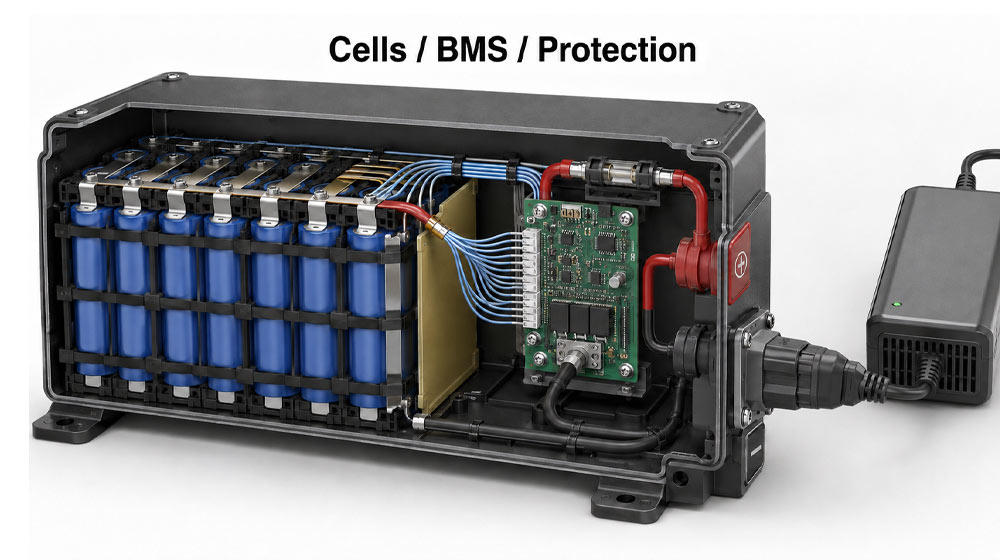
Cells, BMS, enclosure, interconnects, and charger must work as one design.
Compare datasheets and test conditions, not headline cycle-life figures alone.
What Is a LiFePO4 Lithium Battery?
LiFePO4, often shortened to LFP, belongs to the lithium-ion battery family. The term lithium battery covers several chemistries; it does not mean every lithium-ion cell has the same voltage, charging limits, thermal behavior, or energy density. LFP cells are generally described as 3.2 V nominal cells, while many nickel-based lithium-ion cells use a higher nominal cell voltage.
This difference matters during replacement projects. A pack labelled “12 V” may be a 12.8 V four-series-cell LFP pack, but its usable voltage range and required charging profile are not identical to a 12 V lead-acid battery or a three-series nickel-based lithium-ion pack. Treat the device voltage window, charger settings, and BMS cutoffs as engineering inputs.
The misspelling “lifep04 battery” appears frequently in searches, but the correct chemical abbreviation is LiFePO4: “Fe” represents iron and “PO4” represents phosphate.
Why Engineers Choose LiFePO4 Batteries
LiFePO4 batteries are widely used in stationary storage, backup power, solar systems, mobility equipment, marine electronics, industrial devices, and lead-acid replacement projects. Their value comes from the combination of chemistry and pack engineering.
- Thermal and chemical stability: LFP is commonly chosen for applications where a stable chemistry is a priority.
- Cycle-oriented operation: Properly specified LFP packs can support applications that charge and discharge frequently; actual cycle life depends on depth of discharge, temperature, current, charge voltage, and end-of-life definition.
- Flat discharge profile: Output remains relatively steady over much of the discharge, which benefits many loads but makes voltage-only state-of-charge estimation less reliable.
- Reduced routine maintenance: A sealed pack does not require the watering associated with flooded lead-acid batteries.
A long-life cell does not automatically create a long-life battery pack. BMS limits, cell matching, heat, busbars, connectors, and charge strategy determine the result.
LiFePO4 vs Other Lithium Battery Chemistries
LiFePO4 is not universally better than every other lithium-ion chemistry. It is a tradeoff. Nickel-based chemistries can offer higher energy density, which may be more suitable for compact or weight-sensitive products. LFP is often favored when longevity, frequent cycling, thermal stability, or stationary energy throughput carries more weight.
| Decision factor | LiFePO4 tendency | Buyer should confirm |
|---|---|---|
| Nominal cell voltage | Approximately 3.2 V class | Series count and complete pack voltage range |
| Energy density | Usually lower than nickel-rich lithium-ion | Maximum size and weight |
| Cycle use | Well suited to repeat cycling when properly managed | Test conditions, DoD, temperature, and end-of-life threshold |
| Discharge curve | Relatively flat | State-of-charge estimation method |
| Pack protection | BMS still required | Current, temperature, balancing, and communication functions |
Seven Specifications That Define the Right Battery
1. Voltage window
Confirm nominal voltage, maximum charge voltage, discharge cutoff, and the voltage range accepted by the equipment. A matching nominal label is not enough.
2. Required energy
Convert the load into watt-hours: energy (Wh) = average power (W) × runtime (h). Add an engineering margin for conversion losses, temperature, aging, and the usable state-of-charge window. Amp-hours can only be compared meaningfully at the same voltage.
3. Continuous and peak current
Motors, pumps, radios, heaters, and inverters may draw a short peak far above their average current. Cells, BMS, terminals, fuse, and wiring must all tolerate the actual load profile.
4. Temperature
Charging limits and discharging limits are different. Standard LFP packs may prohibit charging below 0°C unless the design includes a verified low-temperature charging strategy or heating function.
5. Mechanical integration
Specify maximum length, width, height, weight, mounting direction, vibration exposure, ingress protection, terminal type, connector, polarity, and wire length.
6. BMS behavior
The BMS should protect against cell overvoltage, undervoltage, overcurrent, and unacceptable temperature. Larger smart packs may also need CAN or RS485 communication and an approved inverter protocol.
7. Documentation
Ask which cell and pack reports apply to the exact configuration. Transport documentation, safety standards, market approvals, and customer qualification are separate questions; a logo or generic certificate list is not a substitute for document review.
Common Buying Mistakes
- Selecting by amp-hours while ignoring voltage and watt-hours.
- Using the BMS cutoff as the normal operating target instead of an emergency protection limit.
- Assuming a lead-acid charger is suitable because the connector fits.
- Ignoring surge current, cable voltage drop, fuse coordination, or terminal torque.
- Comparing cycle-life numbers without identical test conditions.
- Mixing batteries of different chemistry, capacity, age, or state of charge in one bank.
From Sample to Volume Procurement
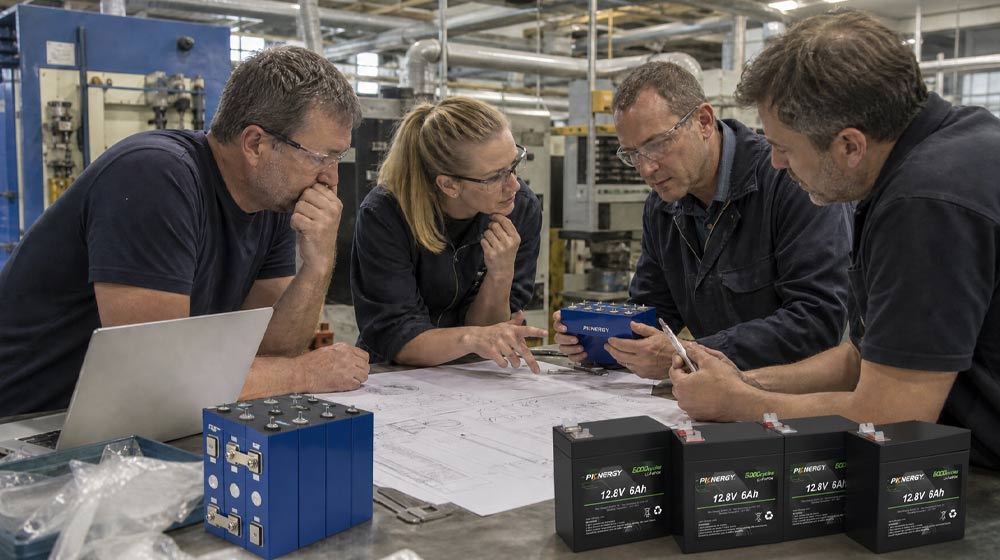
For an OEM project, provide a load profile rather than a single current number. Include average current, peak magnitude and duration, charge source, operating temperature, available space, connector drawing, expected annual volume, destination markets, and required documents. The supplier can then determine whether a standard pack is suitable or whether a custom LiFePO4 battery is justified.
A useful validation plan includes dimensional inspection, connector and polarity checks, functional charge/discharge testing, peak-load testing, thermal observation, BMS fault recovery, and testing in the actual device. Lock the approved cell, BMS firmware or settings, wiring, enclosure, labels, and documents before mass production.
Frequently Asked Questions
Is LiFePO4 a lithium-ion battery?
Yes. LiFePO4 is a lithium-ion chemistry that uses lithium iron phosphate as the cathode material.
Is “lifep04 battery” a different chemistry?
No. “Lifep04” substitutes the number zero for the letter O. LiFePO4 is the correct abbreviation.
Does every LiFePO4 battery need a BMS?
A multi-cell rechargeable pack needs suitable monitoring and protection. The required BMS functions and ratings depend on the pack and application.
Can LiFePO4 replace lead-acid directly?
Sometimes, but verify the charger, alternator or DC-DC source, voltage window, load surge, physical fit, wiring, and low-temperature behavior first.
How do I calculate battery runtime?
Divide usable battery watt-hours by the load watts, then account for inverter losses, temperature, aging, and reserve capacity.
Can different LiFePO4 batteries be connected together?
Only if the manufacturer approves the exact series or parallel arrangement. Use matched batteries with compatible BMS behavior and equal state of charge.
What should a B2B RFQ include?
Include voltage, energy, current profile, dimensions, temperature, charge method, protection, connector, communication, quantity, destination, and documentation requirements.
Define the Battery Around the Application
PKNERGY supplies LiFePO4 cells, standard packs, and application-specific battery solutions. Share your device voltage, load profile, space, environment, connector, and compliance requirements for an engineering review. Final specifications, sample availability, MOQ, lead time, and certifications remain subject to confirmation.
Sources
- PKNERGY LiFePO4 Battery Pack Category — current product direction and available pack families.
- PKNERGY Battery Customization Service — custom pack, BMS, wire, connector, enclosure, and application scope.
- PKNERGY 12V 100Ah LiFePO4 Battery Pack — example pack ratings and test conditions.
- Victron Energy LiFePO4 Battery Manual — manufacturer guidance on BMS protection, charging, and temperature limitations.
Post time: Sep-28-2026