
12V 100Ah LiFePO4 Battery: Hookup, Charger, and Sizing Guide
A 12V 100Ah LiFePO4 battery typically provides about 1.28 kWh of nominal energy because a four-cell LFP pack is commonly rated at 12.8 V. That does not mean every 12V load, charger, or battery hookup is automatically compatible. Before installation, confirm the equipment voltage range, continuous and surge current, BMS limits, charge profile, cable size, fuse, temperature, and the manufacturer’s series/parallel rules.
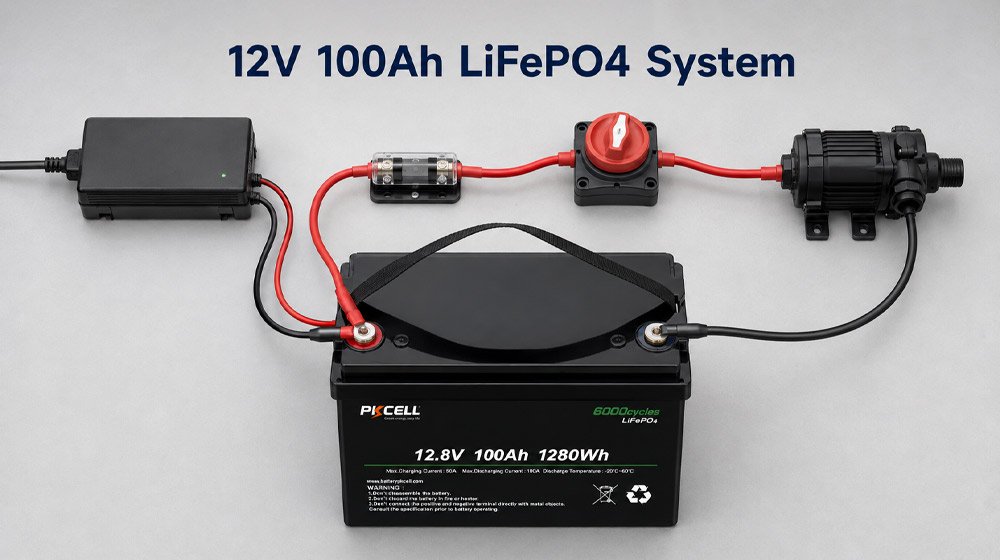
What Does 12V 100Ah Mean?
“12V” identifies the system class, while “100Ah” describes charge capacity. A four-series-cell LiFePO4 pack is normally 12.8 V nominal. In other words, a LiFePO4 12V battery listing usually describes a 12V system class, not an exact 12.0 V value. Its nominal energy is:
Runtime is not simply 1,280 Wh divided by the appliance’s label wattage. Account for inverter efficiency, cable losses, temperature, battery aging, BMS reserve, and the desired state-of-charge floor. For example, a 500 W AC load operating through a 90% efficient inverter draws roughly 556 W from the battery before wiring losses. The theoretical runtime from 1,280 Wh is about 2.3 hours, but a practical design should include reserve and verify the real duty cycle.
The PKNERGY 12V 100Ah product page lists 12.8 V nominal, 1,280 Wh, a 50 A maximum continuous current, and a 400 A pulse rating below 1.5 seconds for that specific model. Those ratings are model-specific. A buyer must compare them with the actual load rather than assuming all 100Ah LiFePO4 batteries have the same BMS or current capability.
Check the Load Before the Battery Hookup
Start at the load. A DC refrigerator, trolling motor, UPS, pump, and inverter impose very different electrical demands even if average daily energy is similar. Record normal current, startup or surge current, surge duration, duty cycle, and acceptable minimum input voltage.
| System question | Why it matters | What to confirm |
|---|---|---|
| Nominal and operating voltage | Prevents load or BMS voltage mismatch | Full accepted DC input range |
| Average power | Determines daily energy and runtime | Watt-hours per operating cycle or day |
| Peak current | May trip the BMS or overheat conductors | Magnitude and duration of startup surge |
| Charge source | Defines charge voltage and current behavior | AC charger, solar controller, alternator/DC-DC, or inverter-charger |
| Environment | Affects charging, discharge, enclosure, and life | Temperature, moisture, vibration, and ventilation |
How to Choose a LiFePO4 Battery Charger
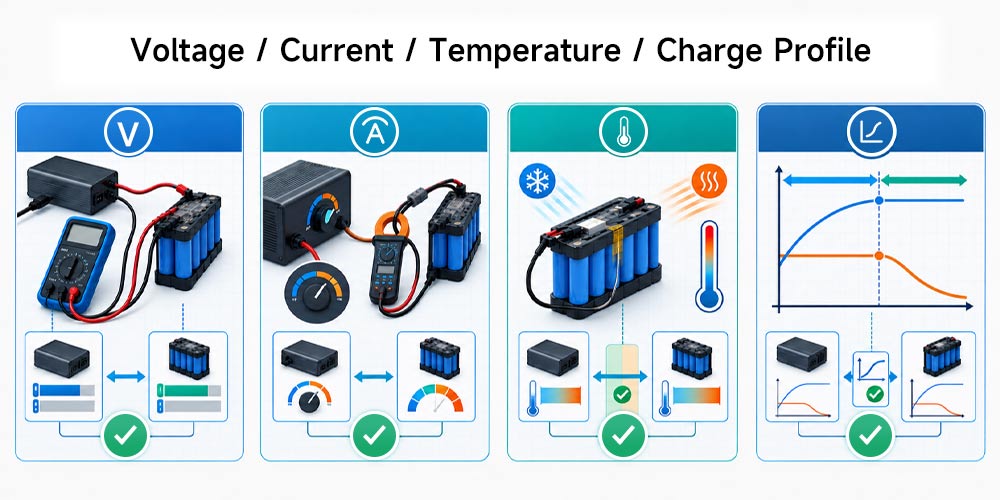
A suitable LiFePO4 charger uses the voltage and current profile approved by the battery manufacturer. It should not apply lead-acid equalization, desulfation pulses, or an unapproved long-term float strategy. The battery’s BMS is a protection layer; it should not be used as the charger’s normal control method.
For the current PKNERGY 12V 100Ah pack page, the published charging specification is CC/CV charging, 14.2–14.6 V maximum charge voltage, 20 A standard charge current, and 50 A maximum charge current. Use the final approved datasheet for the purchased configuration because a different BMS, cell, or product revision can change these limits.
Estimate charging time
A first estimate is battery amp-hours divided by charger amps. A 20 A charger would theoretically replace 100 Ah in five hours. Real charging takes longer because the current tapers during the constant-voltage stage and because charger output, load sharing, temperature, and starting state of charge vary.
Check low-temperature charging
The referenced PKNERGY pack specifies a 0°C to 45°C charging range. If the battery can be below freezing, select a pack with a verified low-temperature cutoff or heating strategy and test the complete system. Do not infer cold-charge capability from the discharge-temperature range.
Safe 12V Battery Hookup Architecture
A basic battery hookup normally includes the battery, correctly rated conductors, a main overcurrent device close to the positive terminal, a disconnect, the load or DC distribution block, and the approved charger. Inverter installations may also require busbars, a shunt, pre-charge provisions, chassis bonding, and manufacturer-specified protective devices.
- Switch off and isolate every charge source and load.
- Verify battery voltage, state of charge, terminal polarity, and equipment ratings.
- Install the fuse or circuit breaker sized to protect the conductor and within the equipment requirements.
- Use the specified terminal hardware and torque. Support cables so terminals do not carry mechanical strain.
- Connect monitoring, communication, or temperature sensors as required.
- Energize according to the battery, inverter, and charger manuals; then confirm polarity and voltage before applying load.
Series and Parallel Connections
Parallel connection increases amp-hour capacity while keeping nominal voltage approximately the same. Series connection increases voltage while amp-hour capacity stays the same. Both arrangements require explicit manufacturer approval.
Use the same model, capacity, age, firmware or BMS type, and state of charge. Provide balanced cable paths in parallel banks and individual branch protection where the system design requires it. Never mix LiFePO4 with lead-acid in a directly paralleled bank. The referenced PKNERGY model page states a limited configuration of up to 25.6 V in series or two packs in parallel; confirm that instruction against the final manual before ordering or installation.
Procurement Checklist for a 100Ah LiFePO4 Battery
- Nominal capacity, energy, and capacity test rate
- Continuous, peak, and short-circuit protection behavior
- Charge voltage, recommended current, maximum current, and temperature limits
- BMS protections, balancing method, reset behavior, and monitoring options
- Case dimensions, weight, ingress rating, terminal type, and torque
- Approved series/parallel quantity and matching requirements
- Applicable UN38.3 test summary, SDS, and destination-market documents
- Warranty terms tied to the intended application and operating limits
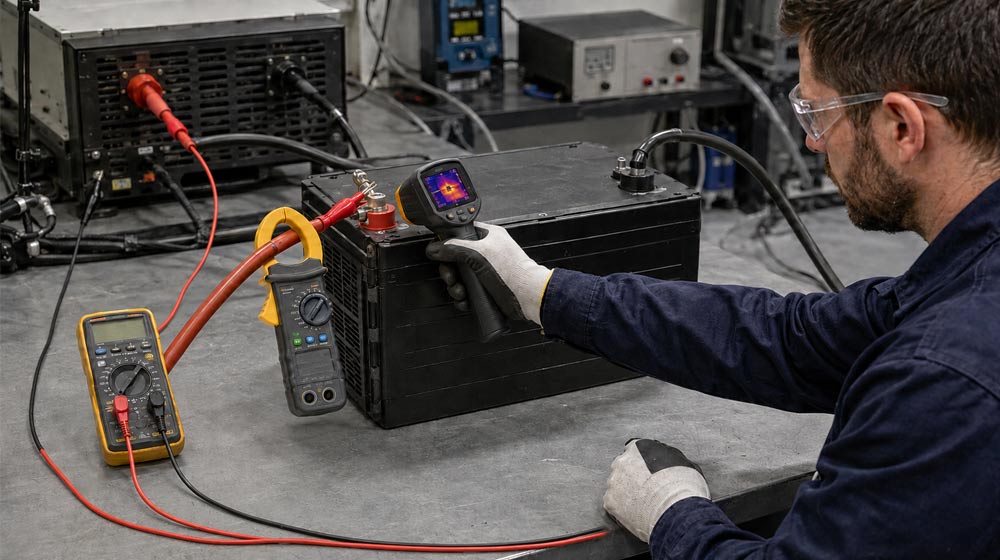
For OEM or volume purchases, validate a sample under the actual charger and load. Capture peak current, terminal temperature, cable voltage drop, charge cutoff behavior, low-state-of-charge operation, and BMS recovery. A datasheet review alone cannot expose every integration issue.
Frequently Asked Questions
How many watt-hours are in a 12V 100Ah LiFePO4 battery?
A 12.8 V, 100 Ah pack has 1,280 Wh of nominal energy. Usable energy depends on operating limits, losses, temperature, and aging.
What size charger should I use for a 100Ah LiFePO4 battery?
Use a charger whose voltage profile and current fall within the exact battery datasheet. Charge time, available AC power, temperature, and concurrent loads also matter.
Can I charge LiFePO4 with a lead-acid charger?
Only when the battery manufacturer approves that charger’s complete profile. Equalization, desulfation, and unsuitable float behavior can create incompatibility.
Can a 100Ah battery run a 1,000 W inverter?
Energy capacity alone cannot answer this. At 12.8 V, a 1,000 W output requires roughly 78 A before inverter losses, so the battery BMS, inverter surge, cables, and fuse must all support the current.
Where should the main fuse be installed?
Normally close to the positive source terminal, with the exact placement and rating determined by the system design, conductor protection requirements, equipment manuals, and code.
Can I connect two 12V 100Ah batteries in parallel?
Only if the manufacturer permits it. Use matched packs at equal state of charge, balanced conductors, and the required branch protection.
Why does the BMS disconnect under load?
Possible causes include excess current, startup surge, low cell voltage, temperature limits, loose connections, or an undersized pack. Diagnose the logged or measured condition before resetting.
Validate the Complete 12V System
PKNERGY offers standard and custom LiFePO4 battery packs for solar, backup, marine, mobility, and industrial applications. Send the load profile, charge source, runtime, enclosure limits, terminal requirements, destination, and expected quantity for a configuration review. Product data, samples, MOQ, lead time, warranty, and documentation are subject to confirmation.
Sources
- PKNERGY 12V 100Ah LiFePO4 Battery Pack — cited product-specific energy, current, charging, temperature, mechanical, and connection data.
- PKNERGY LiFePO4 Battery Pack Category — available product direction and customization context.
- Victron Energy LiFePO4 Battery Manual — manufacturer guidance on battery protection and operating limits.
- OSHA Controlling Electrical Hazards — general electrical hazard and protective-practice context; local rules and equipment manuals still govern installation.
Post time: Sep-28-2026