
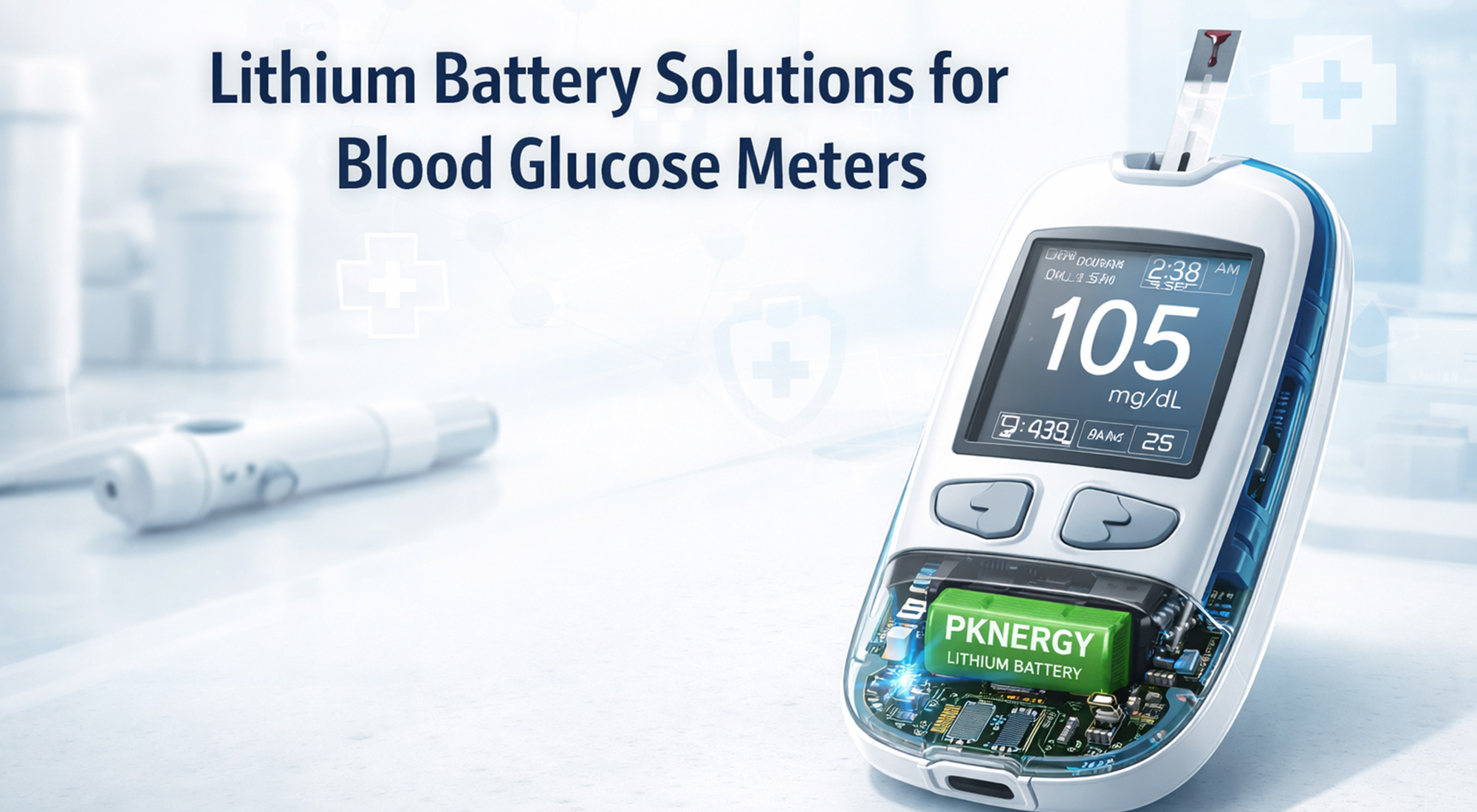
Lithium Battery Solutions for Modern Blood Glucose Meters
Stable, safe, and long-lasting power for compact glucose meters—supporting accurate readings and better patient experience.
Introduction
Blood glucose meters are critical medical devices used daily by millions of people worldwide to manage diabetes. As these devices become more compact, accurate, and connected, the demand for reliable, safe, and long-lasting power sources continues to grow. Lithium batteries have become the preferred solution due to their stable performance, high energy density, and proven safety record in medical electronics.
For manufacturers building next-generation devices, selecting the right battery partner is just as important as selecting the sensing chipset—especially when you need consistent output and dependable protection in a handheld form factor. If you’re exploring custom options, see our Custom Lithium Polymer Battery capabilities and custom battery solutions for specialized requirements.
Why Battery Performance Matters in Blood Glucose Monitoring
A blood glucose meter is not a disposable product; it is a precision medical instrument. Battery performance directly affects:
- Measurement accuracy and stability
- Device standby time and portability
- User confidence and compliance
- Product lifecycle and after-sales reliability
Unstable voltage or rapid capacity degradation can lead to incorrect readings, frequent battery replacements, or even device failure. For medical applications, consistency and reliability are far more important than peak power output.
In practice, this means prioritizing low self-discharge, stable discharge curves, and a robust protection solution—similar to what’s required in other safety-sensitive applications such as security devices and industrial automation systems.
Preferred Lithium Battery Types for Glucose Meters
Most blood glucose meters operate at low power but require stable voltage over long periods. Common lithium battery solutions include:
- Lithium polymer (Li-Po) pouch cells for slim and compact designs
- Small cylindrical lithium-ion cells for devices requiring longer standby time
- Custom single-cell 3.7V lithium packs with protection circuits
These options offer a balanced combination of safety, compact size, and long service life—making them suitable for handheld medical devices. If your product requires specific thickness constraints, wire routing, connector types, or custom PCM/BMS integration, PKNERGY can support battery customization from concept to mass production.
Quick selection guide
- Ultra-slim housing: Li-Po pouch cell (custom thickness)
- Longest shelf/standby time: small cylindrical Li-ion solution
- Fast integration for OEM/ODM: 3.7V custom pack with protection circuit
For more customization references, visit our Battery FAQ and About PKNERGY.
Key Design Considerations
When selecting a lithium battery for a blood glucose meter, manufacturers typically focus on:
- Voltage stability under low and intermittent loads
- Low self-discharge rate for extended shelf life
- High cycle life to support frequent daily use
- Compliance with medical safety standards
Equally important is the integration of a reliable protection circuit to prevent overcharge, over-discharge, and short circuits. For connected meters that include BLE/Wi-Fi modules, stable power delivery under transmission bursts is also important, which is why many OEMs choose a custom Li-Po battery pack engineered around real device duty cycles.
PKNERGY’s Battery Solutions for Medical Devices
At PKNERGY, we provide customized lithium battery solutions tailored specifically for medical electronics. Our batteries are designed to:
- Deliver stable output for precise sensing electronics
- Support compact and ergonomic device designs
- Maintain long-term reliability across thousands of charge cycles
We work closely with customers during the design stage to match battery capacity, size, and electrical characteristics with the actual usage profile of the glucose meter. If your product roadmap includes multiple SKUs (standard / slim / connected), we can help standardize platforms while keeping the battery pack optimized for each design. Start here: Contact Us / Get a Quote.
Typical requirements vs. PKNERGY support
| Glucose Meter Requirement | Battery Solution Support |
|---|---|
| Stable voltage for accurate sensing | Optimized discharge curve + protection circuit integration |
| Long shelf life and standby time | Low self-discharge cell selection + storage guidance |
| Compact industrial design | Custom Li-Po thickness/shape + connector/wiring options |
| Safety and reliability | Protection features: overcharge/over-discharge/short circuit |
Related solutions you may also find useful: Medical Device Power Solution and Power Solutions for Portable Detection Devices.
FAQ
Which battery type is best for a compact blood glucose meter?
For ultra-slim housings, lithium polymer (Li-Po) pouch cells are commonly preferred. For longer standby time in a slightly larger enclosure, small cylindrical lithium-ion cells are often used.
Why is voltage stability more important than peak power for glucose meters?
Glucose meters are precision instruments. Stable voltage helps ensure consistent sensing and measurement performance, while peak output is rarely the limiting factor for low-power medical devices.
Can PKNERGY provide a custom 3.7V pack with protection circuits?
Yes. PKNERGY supports custom single-cell 3.7V lithium packs with protection circuits, including tailored dimensions, wiring, connectors, and protection parameters. See our custom lithium polymer battery page for details.
How do I start an OEM/ODM battery project with PKNERGY?
Send your device size constraints, operating voltage, average/peak current, charging method, and target runtime. You can reach us via Contact Us to get a recommended configuration quickly.
Contact Cassie — PKNERGY
Looking for a reliable lithium battery for blood glucose meters or other handheld medical electronics? Share your device requirements and we’ll propose the best-fit solution.
Post time: Dec-21-2025