
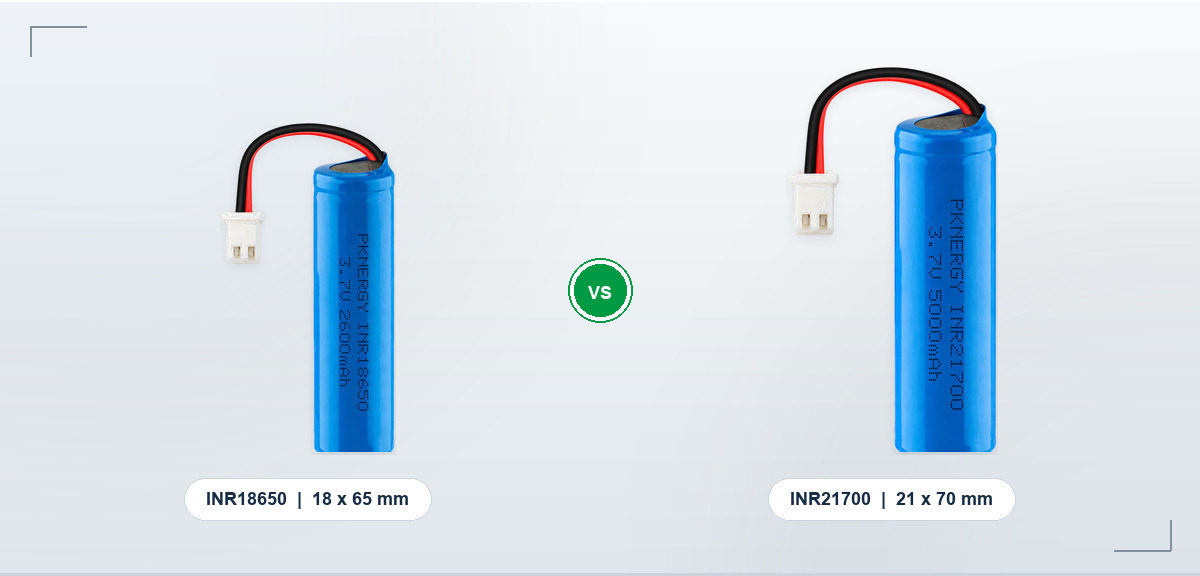
INR18650 and INR21700 are two widely used cylindrical lithium-ion battery formats. Although they share a similar cylindrical structure, their physical dimensions, capacity potential and battery pack design possibilities are different. Choosing between them requires more than comparing the numbers printed on a cell.
For engineers and product developers, the right choice depends on the device’s voltage, energy requirements, discharge current, installation space and operating conditions. The selected cell must also work effectively within the complete battery pack, including its electrical connections, protection circuit and thermal design.
In this article, we compare INR18650 and INR21700 from a battery engineering perspective. We also use four PKNERGY product examples to illustrate the differences between individual cylindrical cells and complete lithium-ion battery packs.
1. Understanding INR18650 and INR21700
The numbers in 18650 and 21700 refer to the nominal dimensions of cylindrical cells. The first two digits indicate the approximate diameter in millimeters, the next two digits indicate the approximate height, and the final digit identifies the cylindrical shape.
| Battery Format | Nominal Diameter | Nominal Height | Cell Shape |
|---|---|---|---|
| 18650 | 18 mm | 65 mm | Cylindrical |
| 21700 | 21 mm | 70 mm | Cylindrical |
The INR prefix is commonly associated with nickel-based lithium-ion cathode systems. However, the exact cathode formulation and performance characteristics depend on the individual cell manufacturer’s design and specifications. The INR designation alone does not define a cell’s capacity, discharge rate or cycle life.
The 21700 format provides more internal volume than the 18650 format. This gives cell manufacturers more design flexibility and can allow higher capacity per cell. However, a larger format does not automatically guarantee better performance in every application.
2. INR18650 vs. INR21700: Cell-Level Comparison
A useful comparison should start with actual product specifications rather than assumptions based only on cell format. The following table uses two PKNERGY cylindrical lithium-ion battery products as examples.
| Specification | PKNERGY INR18650 | PKNERGY INR21700 |
|---|---|---|
| Product Format | INR18650 | INR21700 |
| Nominal Voltage | 3.7V | 3.7V |
| Nominal Capacity | 2600mAh | 5000mAh |
| Configuration | 1S1P | 1S1P |
| Maximum Discharge Current | 13A | 25A |
| Standard Discharge Rate | 1.5C | 1.5C |
| Charging Voltage | 4.2V | 4.2V |
| Cycle Life | 300 cycles (80% SOC) | 300 cycles (80% SOC) |
| Charge Temperature | 0°C to 45°C | 0°C to 45°C |
| Discharge Temperature | -20°C to 60°C | -20°C to 60°C |
Explore the PKNERGY cell products:
In these PKNERGY examples, both products have a nominal voltage of 3.7V and a 1S1P configuration. The INR21700 product provides a rated capacity of 5000mAh, compared with 2600mAh for the INR18650 product. Their listed maximum discharge currents are 25A and 13A, respectively.
These specifications illustrate the differences between these two particular products. They should not be treated as universal performance limits for every INR18650 or INR21700 cell available on the market.
3. Capacity, Energy and Discharge Performance
Capacity: Understanding mAh
Capacity is commonly expressed in ampere-hours (Ah) or milliampere-hours (mAh). It describes the amount of electrical charge a battery can deliver under specified test conditions.
In the PKNERGY examples above, the INR21700 5000mAh product has a higher nominal capacity than the INR18650 2600mAh product. This can be useful in equipment that requires longer operating time without increasing the number of parallel cells.
Energy: Why Wh Matters
Capacity alone does not describe the total energy stored in a battery. Nominal energy is calculated using both nominal voltage and capacity:
For the two single-cell product examples:
- INR18650: 3.7V × 2.6Ah = 9.62Wh
- INR21700: 3.7V × 5.0Ah = 18.50Wh
Because both products have the same nominal voltage, their Wh values provide a straightforward comparison of nominal energy. When comparing complete battery packs with different voltage configurations, Wh becomes even more important.
Discharge Capability
Discharge current indicates how much current a battery can supply under specified conditions. It is particularly important for equipment with motors, actuators, heating elements or other high-power loads.
The PKNERGY INR18650 2600mAh product lists a maximum discharge current of 13A, while the INR21700 5000mAh product lists 25A. These are product-specific values. Actual current limits must be evaluated together with temperature, wiring, protection circuitry and the operating profile of the device.
Thermal and Safety Considerations
A battery’s thermal behavior is influenced by internal resistance, current demand, cell construction, ambient temperature and the design of the complete battery pack. A larger cell format does not by itself guarantee a safer battery.
Engineers should evaluate temperature rise, charging limits, discharge limits, insulation, mechanical protection and the required battery management or protection circuit. The finished pack should be validated under its intended operating conditions.
4. How Battery Pack Configurations Work
Individual cylindrical cells can be connected in series, parallel, or a combination of both to meet the voltage and capacity requirements of an electronic device.
Series Connection (S)
Connecting cells in series increases the total nominal voltage, while the Ah capacity remains approximately the same as that of one series group. For example, a 2S lithium-ion pack uses two cell groups connected in series.
Parallel Connection (P)
Connecting cells in parallel increases the total capacity and current capability while maintaining approximately the same nominal voltage. A 2P configuration connects two cells or cell groups in parallel.
Combined Series and Parallel Configuration
A 2S2P configuration combines two series groups with two parallel cells in each group. A 3S1P configuration connects three cells in series without parallel groups.
The final battery pack voltage, capacity and energy depend on the cell specifications and the selected configuration. Pack-level design must also account for the BMS or PCM, wiring, connectors, insulation, mechanical structure and thermal requirements.
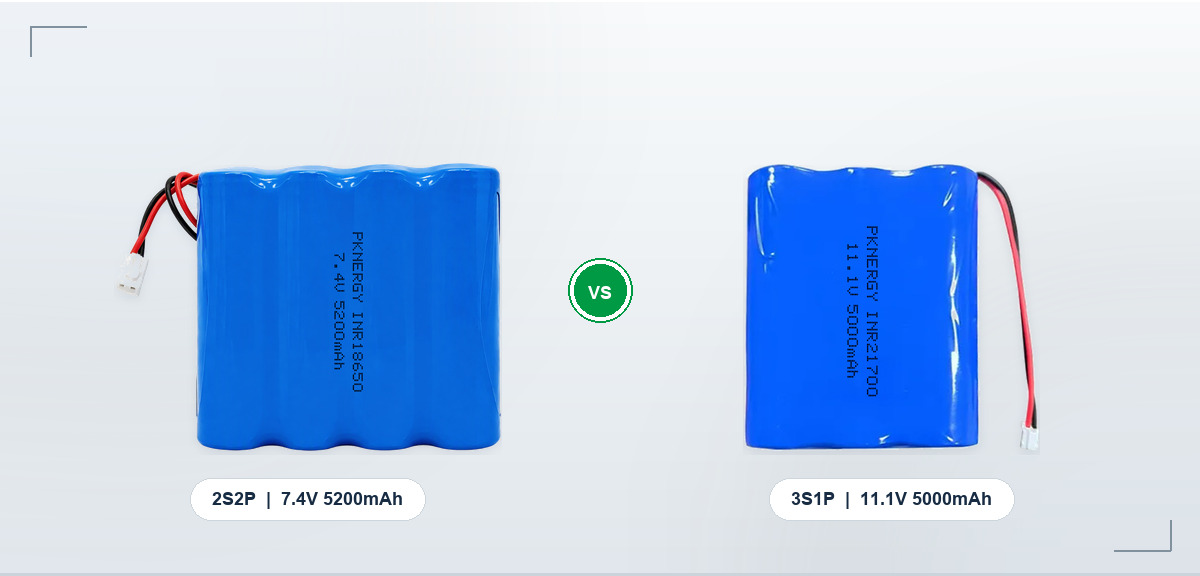
5. PKNERGY INR18650 and INR21700 Battery Pack Comparison
The cell format is only one part of a battery design. For OEM equipment manufacturers, the complete battery pack must meet the device’s voltage, capacity, charging, discharge, protection and installation requirements.
The following examples compare two PKNERGY complete battery packs. The table uses the latest engineering specifications supplied for these configurations.
| Specification | INR18650 Battery Pack | INR21700 Battery Pack |
|---|---|---|
| Cell Format | INR18650 | INR21700 |
| Configuration | 2S2P | 3S1P |
| Number of Cells | 4 | 3 |
| Nominal Voltage | 7.4V | 11.1V |
| Rated Capacity | 5200mAh | 5000mAh |
| Nominal Energy | 38.48Wh | 55.50Wh |
| Charging Current | 7.80A | 7.50A |
| Charging Rate | 1.5C | 1.5C |
| Maximum Discharge Current | 15.60A | 15.00A |
View the complete PKNERGY battery pack products:
Why Does the 21700 Pack Have More Nominal Energy?
The two battery packs have similar rated capacities: 5200mAh for the INR18650 2S2P pack and 5000mAh for the INR21700 3S1P pack. However, their nominal voltages are different.
The INR18650 pack uses a 2S configuration with a nominal voltage of 7.4V, while the INR21700 pack uses a 3S configuration with a nominal voltage of 11.1V.
Their nominal energy values are calculated as follows:
- INR18650 2S2P: 7.4V × 5.2Ah = 38.48Wh
- INR21700 3S1P: 11.1V × 5.0Ah = 55.50Wh
Although the INR21700 pack has a slightly lower mAh rating, its higher nominal voltage results in a higher nominal energy value. This demonstrates why Wh is generally more useful than mAh when comparing complete battery packs with different voltage configurations.
Cell Format Does Not Determine Pack Configuration
The two PKNERGY examples also demonstrate that cell format and pack configuration are separate design decisions. The INR18650 example uses four cells in a 2S2P arrangement, while the INR21700 example uses three cells in a 3S1P arrangement.
The correct configuration depends on the device’s required voltage, capacity, current and mechanical layout. A battery pack should be designed around the application rather than selected by cell format alone.
6. Typical Applications of INR18650 and INR21700
Both cylindrical formats can be used in consumer electronics and industrial equipment. The best option depends on the device’s energy demand, available space and electrical requirements.
Common INR18650 Applications
- Portable electronic equipment
- Medical and monitoring devices
- Industrial handheld instruments
- Portable lighting equipment
- Compact rechargeable battery packs
The PKNERGY INR18650 3.7V 2600mAh battery is one example of a compact cylindrical battery product for portable equipment and customized battery applications.
Common INR21700 Applications
- Portable equipment requiring higher capacity
- Power tools and industrial devices
- Portable power systems
- Electronic equipment with higher energy requirements
- Custom battery packs for OEM products
For applications requiring a higher-capacity cylindrical cell, the PKNERGY INR21700 3.7V 5000mAh battery provides another option for product developers.
These are general application examples rather than strict format limitations. Both cell formats can be integrated into different battery pack designs when the selected cell and finished pack meet the device’s requirements.
7. How to Choose the Right Format
There is no single battery format that is always better. A practical selection process should begin with the electrical and mechanical requirements of the target device.
Consider INR18650 When:
- The device has limited internal installation space.
- A compact cylindrical cell format is preferred.
- The required voltage and capacity can be achieved with a suitable 18650 configuration.
- The selected cell meets the application’s discharge requirements.
Consider INR21700 When:
- The design requires higher capacity per cell.
- The device can accommodate a larger cylindrical format.
- A higher energy target can be achieved with a suitable pack configuration.
- The selected cell meets the required current and thermal performance.
Key Engineering Factors Before Selection
- Voltage requirements: Confirm the device’s operating voltage and required series configuration.
- Energy requirements: Calculate the required Wh based on operating time and power consumption.
- Discharge current: Check continuous and peak current requirements against the approved cell and pack specifications.
- Charging requirements: Confirm the charging voltage, current and temperature limits.
- Mechanical design: Check the available space, mounting method, wiring and connector requirements.
- Battery protection: Specify the appropriate BMS or PCM and required protection functions.
- Operating environment: Evaluate ambient temperature, vibration, humidity and other application conditions.
For OEM and ODM projects, it is important to evaluate the complete battery system rather than choosing a cell based only on its nominal capacity. Cell selection, pack configuration, protection design and manufacturing quality all contribute to the final battery’s performance and reliability.
8. Frequently Asked Questions
Is an INR21700 battery better than an INR18650 battery?
Not necessarily. A 21700 cell has a larger physical format and can offer higher capacity per cell in many designs. However, the best choice depends on the specific cell model, electrical requirements, available space and application.
What is the capacity difference between INR18650 and INR21700?
Capacity varies by cell model. In the PKNERGY product examples in this article, the INR18650 cell is rated at 2600mAh, while the INR21700 cell is rated at 5000mAh. These are specifications of the listed products, not universal limits for each format.
Can INR18650 and INR21700 cells be used in the same battery pack?
Combining different cell formats in one battery pack is generally not recommended unless the design has been specifically engineered and validated for that purpose. Differences in capacity, internal resistance, thermal behavior and electrical characteristics can affect pack performance and safety.
What is the difference between mAh and Wh?
mAh measures electrical capacity, while Wh measures electrical energy. Wh accounts for both voltage and capacity, making it more suitable for comparing battery packs with different nominal voltages.
Can PKNERGY customize INR18650 and INR21700 battery packs?
PKNERGY provides lithium-ion battery pack products and customization support for OEM and ODM applications. Pack requirements can be evaluated according to voltage, capacity, discharge current, charging requirements, dimensions, connectors and operating conditions.
Looking for a Custom INR18650 or INR21700 Battery Pack?
Selecting the right cylindrical cell is only the first step. A well-designed battery pack must match the electrical, mechanical and operating requirements of the final device.
PKNERGY supports OEM and ODM customers with customized lithium-ion battery pack solutions, including cell selection, series-parallel configuration, protection circuit integration and pack-level engineering.
Explore our INR18650 battery pack and INR21700 battery pack, or contact our team to discuss your project.
Post time: Nov-27-2026