
Custom Lithium Battery Solutions for OEM Electronics in 2026
In 2026, OEM manufacturers are under growing pressure to build products that are lighter, safer, longer-lasting, and easier to integrate into compact device architectures. That is why off-the-shelf batteries are losing ground to custom lithium battery solutions designed around exact product requirements.
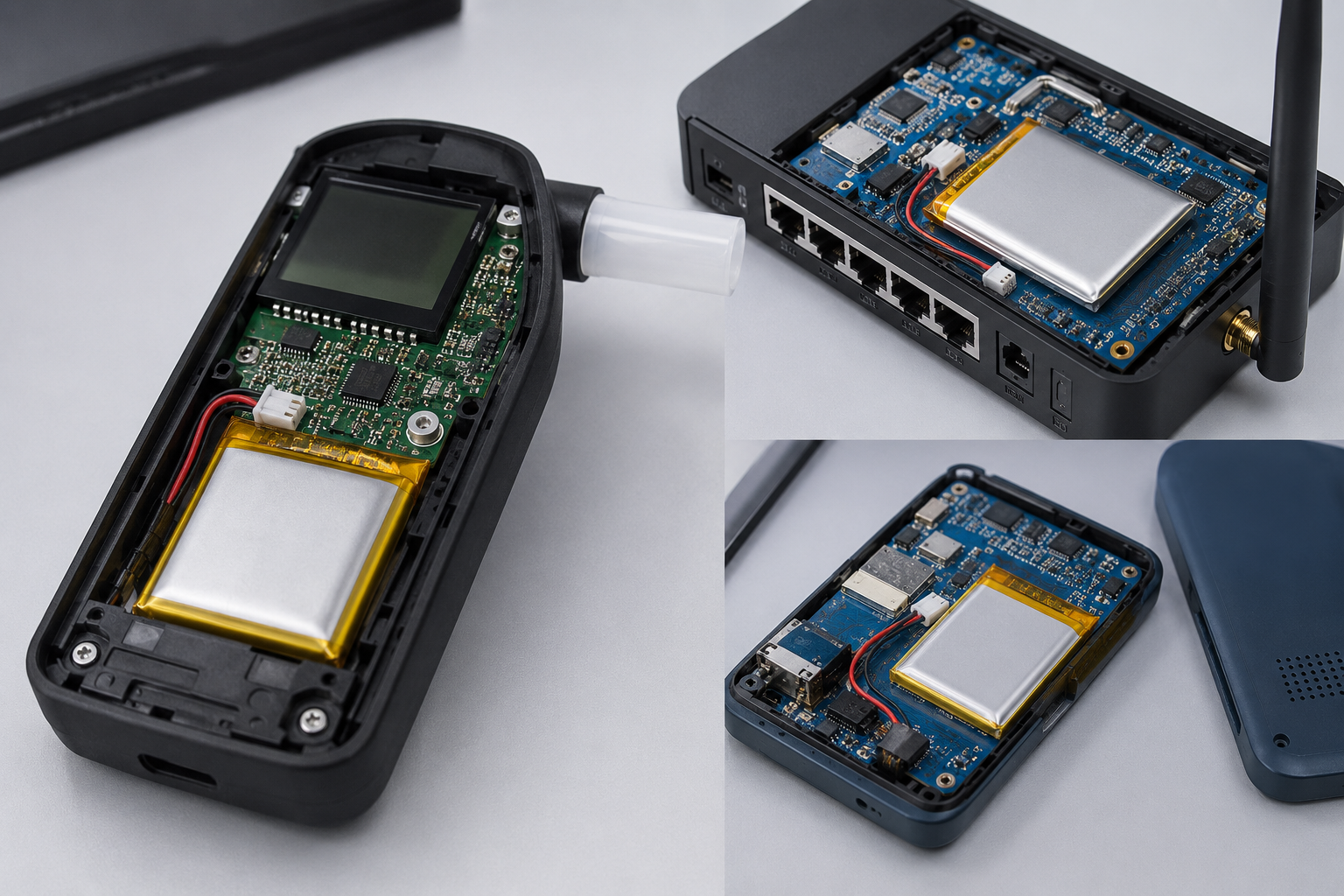
From square lithium batteries for alcohol testers and modems to advanced packs for smart electronics and energy systems, battery design has become a product strategy decision, not just a sourcing decision.

Why Custom Lithium Battery Solutions Matter More in 2026
Battery selection is now closely tied to the commercial success of a device. A poorly matched battery can create charging instability, wasted internal space, overheating risk, shorter runtime, and early replacement problems. A well-designed custom battery pack can do the opposite: improve efficiency, extend service life, and simplify the product experience for end users.
Tighter Product Design Is Driving Customization
Modern electronics rarely have extra internal room. OEM teams are designing slimmer, smarter, and more application-specific products, which means battery form factor has to follow the product instead of forcing the product to follow the battery.
That is especially true in square and compact battery formats used in products such as:
- Alcohol testers and other handheld diagnostic devices
- Modems and communication hardware
- Portable electronic products with limited enclosure space
- Smart home devices that require long standby time
Lifecycle Economics Are Replacing Simple Unit Cost Thinking
OEM buyers are looking beyond the purchase price of a cell. They increasingly evaluate total lifecycle value, including service life, field failure risk, maintenance burden, thermal behavior, and integration cost. This is one reason lithium batteries continue to displace lead-acid options in many modern systems.
In 2026, the smarter battery choice is not always the cheapest battery. It is the battery that delivers the best balance of fit, safety, runtime, and long-term reliability.
How Square Lithium Batteries Fit Compact OEM Devices
The uploaded product prompt points to square lithium battery formats such as 552530, 503035, and 803860, with target applications including alcohol testers, modems, and electronic products. These kinds of dimensions matter because compact devices often need a battery that fits around board layouts, connectors, sensors, and casing restrictions.
Why Square Formats Are Practical
- They use enclosure space more efficiently than many cylindrical alternatives.
- They can help reduce dead space in thin, rectangular device housings.
- They support cleaner internal product architecture for handheld and embedded electronics.
- They are often suitable for lightweight designs where balance and portability matter.
Application Engineering Is More Important Than Cell Shape Alone
A battery size code by itself does not guarantee performance success. OEM teams still need to validate nominal voltage, capacity, discharge behavior, charging profile, connector type, protection circuit, and operating environment. In other words, the geometry may start the selection process, but the application defines the final specification.
Key Technical Factors OEM Manufacturers Should Evaluate
When specifying a custom lithium battery solution, engineering teams should align battery design with real operating conditions instead of using generic assumptions.
1. Nominal Voltage and System Compatibility
PKNERGY notes that different chemistries use different nominal voltages. For example, lithium-ion and lithium polymer batteries commonly use 3.7V, while LiFePO4 batteries commonly use 3.2V. This difference affects charger design, power conversion, protection settings, and load behavior.
| Battery Chemistry | Typical Nominal Voltage | Where It Often Fits Best |
|---|---|---|
| Lithium-ion | 3.7V | General portable electronics, moderate-to-high energy density use cases |
| Lithium Polymer | 3.7V | Thin or custom-shaped products where packaging flexibility matters |
| LiFePO4 | 3.2V | Safety-focused systems, long-cycle applications, energy storage, industrial backup |
2. Thermal Management and Safety Margin
Battery heating can result from fast charging, high discharge current, internal resistance, poor thermal design, or cell aging. In compact electronics such as modems or portable testers, there is often less room for passive heat dissipation, which makes pack design and protection logic more important.
3. Cycle Life and Replacement Strategy
For products expected to operate over long service intervals, cycle life directly affects field cost. According to PKNERGY, LiFePO4 batteries can often deliver far more charging cycles than conventional lithium battery ranges, making them attractive where uptime and replacement intervals matter more than ultra-compact size.
4. Battery Management System Integration
A battery pack is only as dependable as the intelligence protecting it. Advanced Battery Management Systems help defend against overcharging, over-discharging, overcurrent, overheating, and short circuits. For OEM programs, that protection is not just a technical feature. It is a risk-control requirement.
Why LiFePO4 Is Expanding While Custom Lithium Packs Still Dominate Electronics
One of the more important 2026 trends is the rise of LiFePO4 in safety-sensitive and long-life applications such as solar storage, RV power, telecom energy storage, marine systems, and industrial backup. Its appeal comes from better thermal stability, lower overheating risk, stronger fire resistance, and long usable life.
At the same time, many compact OEM electronics still depend on custom lithium-ion or lithium polymer battery packs because they need high energy density, lighter weight, or packaging flexibility. That means the winning strategy is not choosing one chemistry for every scenario. It is matching chemistry to product intent.
Use LiFePO4 When Priorities Include:
- Long cycle life
- Improved thermal stability
- Industrial or energy-storage durability
- System-level safety emphasis
Use Custom Li-ion or LiPo When Priorities Include:
- Compact product packaging
- Thin or square cell formats
- Portable device runtime in limited space
- Product-specific shape and connector requirements
Industries Pushing the Shift Toward Advanced Custom Battery Solutions
Medical Devices
Battery failure is unacceptable in healthcare environments. Portable monitors, infusion pumps, diagnostic equipment, and medical carts all require stable voltage, dependable runtime, and strong protection logic.
Drones and Robotics
These platforms demand lightweight design, high discharge rates, and fast charging. Compact battery engineering can directly influence mission time and product responsiveness.
Energy Storage Systems
Residential and commercial storage systems need long cycle life, stable output, scalable design, and advanced BMS protection. This is where rack-mounted LiFePO4 systems are gaining ground.
Smart Home and Embedded Electronics
Smart locks, sensors, communication modules, and portable appliances often need low-maintenance batteries that fit tight enclosures while preserving standby performance. This is a natural fit for customized lithium battery solutions.

What OEM Buyers Should Ask a Battery Manufacturer Before Launch
- Can the supplier customize dimensions, voltage, capacity, connector, and protection design for the device?
- Which chemistry best matches the product’s runtime, safety, and packaging priorities?
- How is thermal performance validated under real load conditions?
- What quality-control process is used to reduce field failure risk?
- Can the supplier support both pilot builds and large-scale production?
According to PKNERGY, its positioning in the market includes lithium-ion batteries, LiFePO4 batteries, lithium polymer batteries, custom battery packs, and OEM/ODM support. For buyers, that matters because scaling a battery program usually requires both engineering flexibility and production consistency.
FAQ
Because many modern products need exact dimensions, voltages, capacities, discharge rates, and protection features that standard batteries cannot provide. Customization helps improve fit, runtime, safety, and product integration.
They can be a better fit when the enclosure is thin or rectangular and internal space is limited. However, the final decision should still be based on electrical requirements, heat behavior, cycle life, and protection design.
LiFePO4 is often a strong choice when safety, thermal stability, and long cycle life matter more than maximum packaging flexibility or the highest possible energy density.
BMS protects the battery from unsafe operating conditions such as overcharge, over-discharge, overcurrent, short circuit, and overheating. It also supports better system stability and battery longevity.
Conclusion
The biggest lithium battery trend in 2026 is not just chemistry improvement. It is the move toward application-specific battery engineering. OEM manufacturers want battery systems that match the device, the use case, and the performance target from the beginning.
For compact electronics such as alcohol testers, modems, and other embedded products, square lithium battery formats and custom pack design can provide a real competitive edge. For larger or safety-driven systems, LiFePO4 and advanced BMS integration continue to gain momentum. The common thread is clear: the battery is now a design lever, not a commodity part.
Post time: May-27-2026