
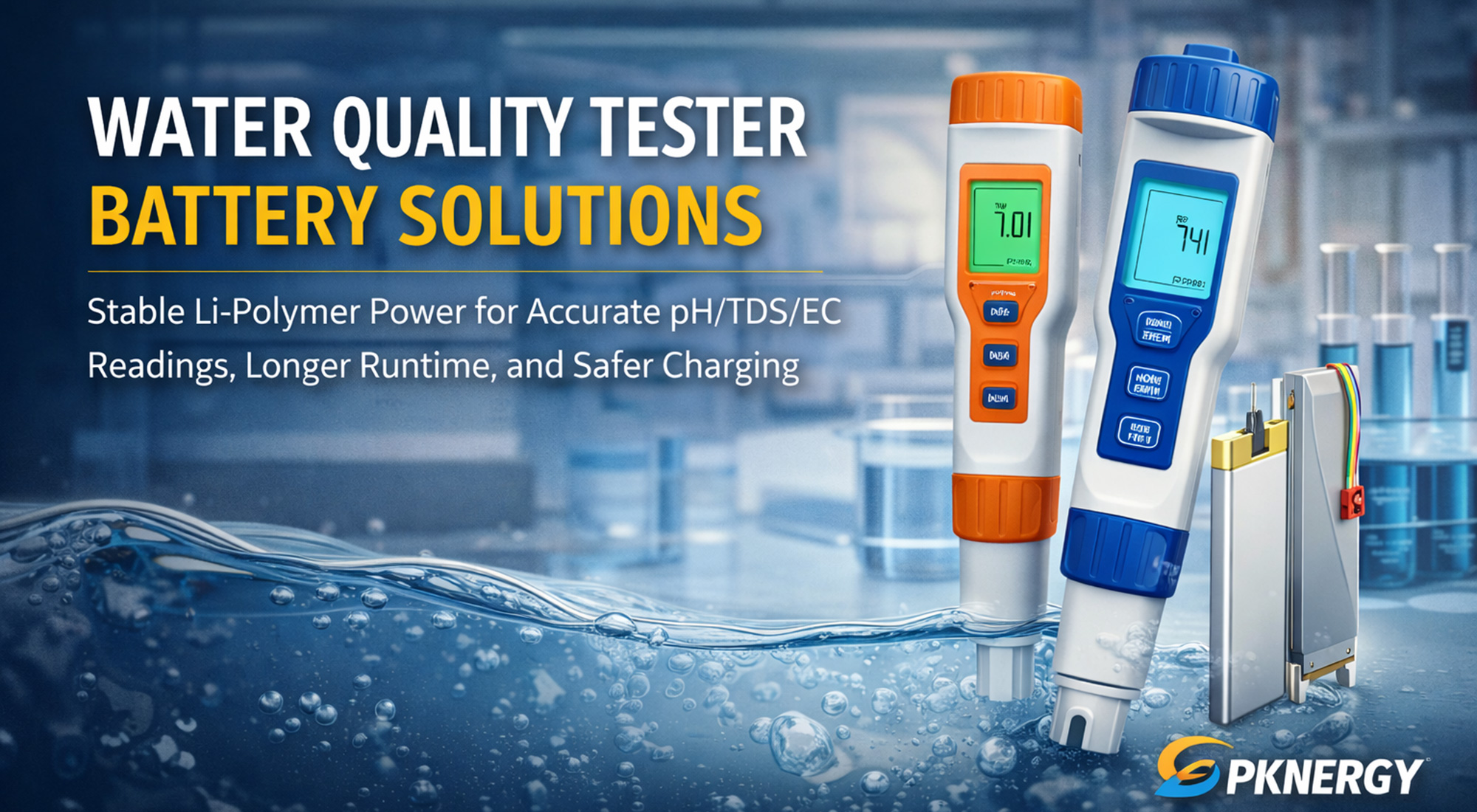
Water Quality Tester Battery Solutions
Stable Li-Polymer power for accurate pH/TDS/EC readings, longer runtime, and safer charging
Battery Application Solutions
instruments used in drinking water testing, aquariums, hydroponics, laboratories, pool maintenance,
and industrial water monitoring. As functions increase—digital display, auto-calibration,
temperature compensation, data hold, and USB charging—the battery system has become a critical
factor in ensuring accuracy and reliability.If you’re developing or upgrading a pen-style tester, PKNERGY supports both standard cells and
custom lithium polymer battery
designs to match tight internal space and stable measurement demands.
Industry Background
Traditional water testers used coin cells or AAA batteries, suitable only for low-power analog measurement.
Modern smart testers require significantly more energy due to:
- Digital displays
- Backlight screens
- Auto-temperature compensation
- Multi-parameter measurement (pH / TDS / EC)
- Built-in processors
- USB charging modules
These features require stable, rechargeable lithium-polymer (Li-Po) batteries that deliver consistent
power in a compact form factor. For OEM projects, PKNERGY can also provide
custom LiFePO4 battery
options if your product targets longer cycle life and stronger safety margin in specific use cases.
Pain Points in Today’s Water Quality Testers
1. Unstable voltage during measurement causes reading drift
Water testers require consistent voltage to maintain probe stability. Low-quality batteries with high internal
resistance often cause screen flickering, reading instability, random restarts, and drift during calibration.
PKNERGY Advantage:
- Low-internal-resistance Li-polymer cells
- Stable output ensures accurate probe readings
- Prevents drifting, misreading, and inconsistent values
2. Fake capacity leads to extremely short runtime
Many low-cost testers claim “800 mAh / 1000 mAh” but internally may use 150–300 mAh cells, recycled batteries,
or mismatched aging cells—leading to poor endurance and frequent charging.
PKNERGY Advantage:
- True capacity Li-Po cells (300–800 mAh optional)
- Full quality-consistency testing
- Reliable long-term endurance
3. Over-discharge damages sensors and calibration data
Water quality sensors are sensitive to voltage irregularities. Over-discharging can cause value drift,
calibration loss, reduced sensor lifespan, and long-term inaccuracy.
PKNERGY Advantage:
- Integrated protection circuits (over-charge / over-discharge / short-circuit)
- Stable voltage helps protect sensor accuracy
- Extends probe life
For devices used in automation or on-site inspection workflows, you can also reference our
industrial automation battery solution
approach to improve reliability under frequent usage cycles.
4. Small device size limits battery options
Water quality testers are long, slim, and compact. Internal space is limited by the probe assembly,
main PCB, display, and protective casing—making standard batteries hard to fit.
PKNERGY Advantage:
- Custom Li-polymer shapes (long strips / ultra-thin / narrow type)
- Perfect fit for internal structure
- Supports full custom mechanical design
Need a fast-turn custom pack? Start here:
Contact Us.
Why Li-Polymer Batteries Are Ideal for Water Testers
- Lightweight and slim — fits long, pen-style designs
- Customizable shape for limited internal space
- Stable voltage for precise electronic measurement
- USB-rechargeable — modern user-friendly experience
- High cycle life compared to coin cells or alkaline batteries
For more customization examples and FAQs about connectors, PCM, and certifications, you may also refer to
PKNERGY Battery FAQ.
PKNERGY Solutions for Water Quality Testers
1) Li-Polymer Battery Options (3.7V / 300–800 mAh)
Designed for:
- Compact consumer testers
- Smart digital testers
- Multi-parameter testing pens
2) Full battery-pack customization
- PCM/BMS protection board
- Wiring harness
- Connector customization
- Certifications available (UN38.3 / IEC62133)
Learn more about PKNERGY background and manufacturing capability:
About PKNERGY.
3) Engineering-matched solutions
- Fits mechanical drawings or STEP files
- Optimized for thermal and electrical stability
- Enhanced safety and durability
Application Scenarios
PKNERGY Li-polymer batteries support devices used in:
- Drinking water testing
- Aquariums / saltwater tanks
- Hydroponics & agriculture
- Pool and spa maintenance
- Laboratory experiments
- Industrial water quality inspection
FAQ
What battery is best for pen-style water quality testers?
Most modern pen-style testers benefit from a 3.7V lithium-polymer (Li-Po) battery because it is slim,
customizable in shape, and provides stable voltage for accurate electronic measurement.
Can you provide a complete battery pack with protection and connectors?
Yes. PKNERGY can supply the Li-Po cell plus PCM/BMS protection, wiring harness, and customized connectors.
We also support certifications such as UN38.3 and IEC62133 when required.
How do you prevent reading drift and calibration loss?
We use low-internal-resistance cells for stable output and add protection circuits to prevent over-discharge,
helping maintain sensor stability and protecting calibration data.
Conclusion — Reliable Measurement Starts with a Reliable Battery
Water quality testers measure “numbers,” but behind every number is an electronic system that depends on stable power.
Poor-quality batteries can cause reading drift, sudden shutdown, fast battery drain, calibration loss, and sensor degradation.
Leading brands are upgrading their batteries—because accurate water testing requires stable, clean, and durable power.
PKNERGY is the trusted partner that provides precisely that.
Discuss Your Water Quality Tester Battery Project with PKNERGY
Contact Miah — Product Expert at PKNERGY
Email: sale@pknergy.com
WhatsApp: +86 139 0246 3897
Quick quote link:
Get a Quote
Post time: Dec-17-2025