
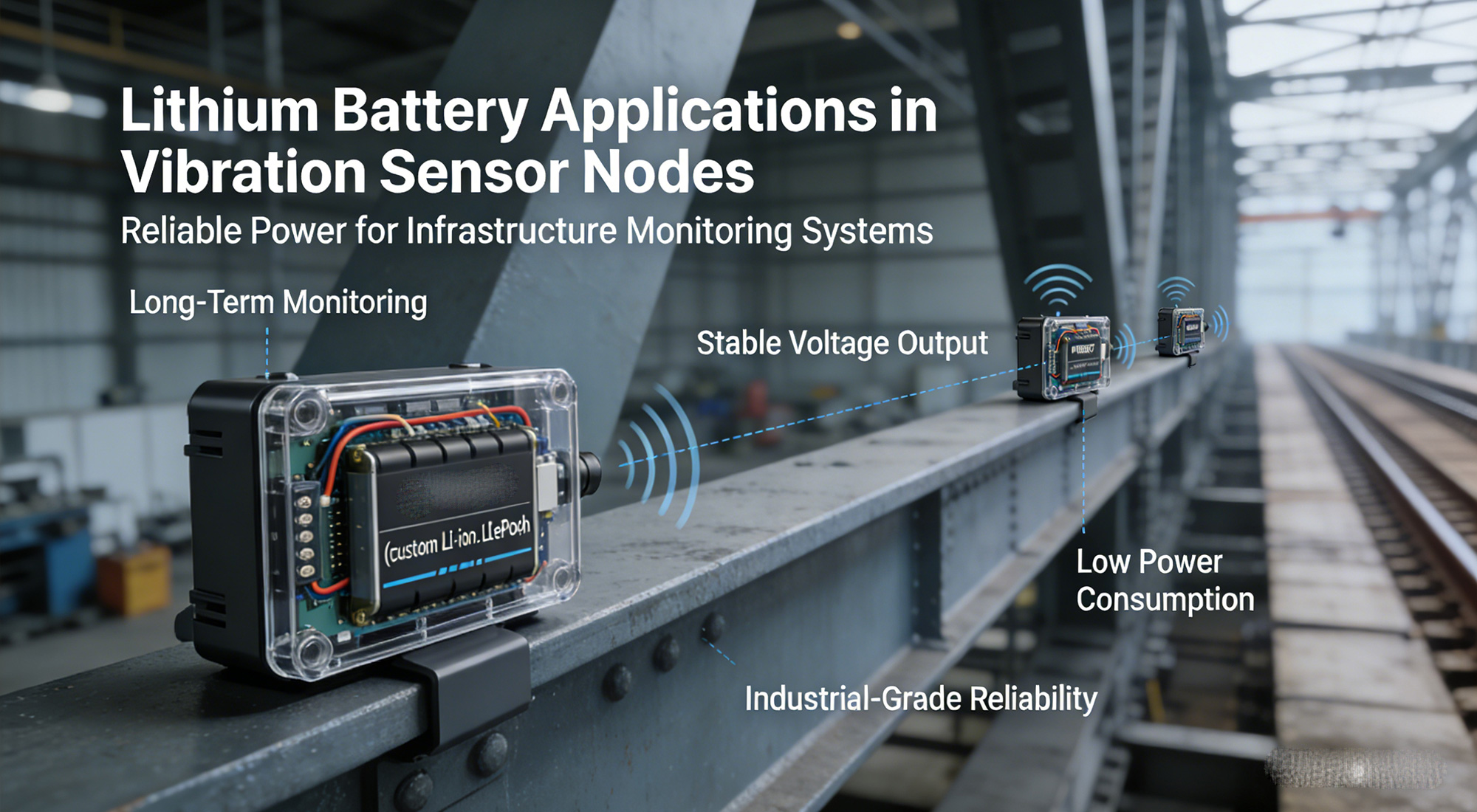
Lithium Battery Applications in Vibration Sensor Nodes for Infrastructure Monitoring
Reliable lithium power solutions for long-term vibration monitoring and predictive maintenance
Infrastructure Monitoring · Vibration Sensor · Lithium Battery
Industry Background
Vibration sensor nodes are widely used in infrastructure monitoring to detect structural changes,
mechanical faults, and abnormal operating conditions. Typical applications include bridges,
railways, industrial equipment, and smart buildings.
As smart infrastructure and predictive maintenance systems become more prevalent, vibration
monitoring networks are increasingly deployed in distributed environments where wiring is
impractical or costly. In these scenarios, battery-powered operation becomes the preferred solution.
Compared with traditional power options, lithium batteries offer higher energy density and longer
service life, making them ideal for remote monitoring systems and
industrial automation battery solutions
.
Power Requirements of Vibration Sensor Nodes
Vibration sensors and data acquisition modules require stable and clean power to ensure measurement
accuracy. While most sensor nodes remain in ultra-low-power standby mode, they periodically activate
sensors, processors, and wireless transmitters.
This operating pattern means batteries must support both low average current consumption and short
bursts of peak discharge. Poor battery selection can lead to voltage instability, data loss, or
reduced sensor accuracy.
Benefits of Lithium Battery Technology
Lithium battery technology provides an optimal balance between performance, size, and reliability
for vibration sensor nodes.
- High energy density enabling compact battery pack design
- Stable discharge voltage for accurate sensor measurement
- Long cycle life and low self-discharge for multi-year operation
- Reduced maintenance frequency across large-scale deployments
These advantages make lithium batteries a preferred choice for
custom lithium battery packs
used in monitoring and sensing equipment.
Reliability and Safety Considerations
In infrastructure monitoring applications, system reliability is critical. Battery failure can
result in data gaps, missed fault detection, or increased maintenance costs.
Lithium battery packs for vibration sensor nodes are typically designed with integrated protection
circuits, including overcharge, over-discharge, and short-circuit protection. High-quality cells
combined with consistent manufacturing processes further enhance long-term stability and safety.
Charging and Maintenance Strategies
Some vibration monitoring systems integrate energy harvesting methods such as solar power or
vibration energy harvesting. Lithium batteries work effectively as energy buffers in these hybrid
systems, storing harvested energy and delivering stable output to sensor electronics.
Their predictable performance simplifies maintenance planning and reduces the total cost of
ownership for infrastructure operators.
PKNERGY’s Expertise in Sensor Battery Solutions
PKNERGY provides customized lithium battery solutions for vibration sensor nodes used in
infrastructure monitoring, industrial equipment diagnostics, and smart building systems.
Our capabilities include cell selection, pack structure design, BMS integration, and
environmental adaptation. Learn more about our
custom LiFePO4 battery solutions
for high-reliability applications.
Post time: Feb-04-2026