
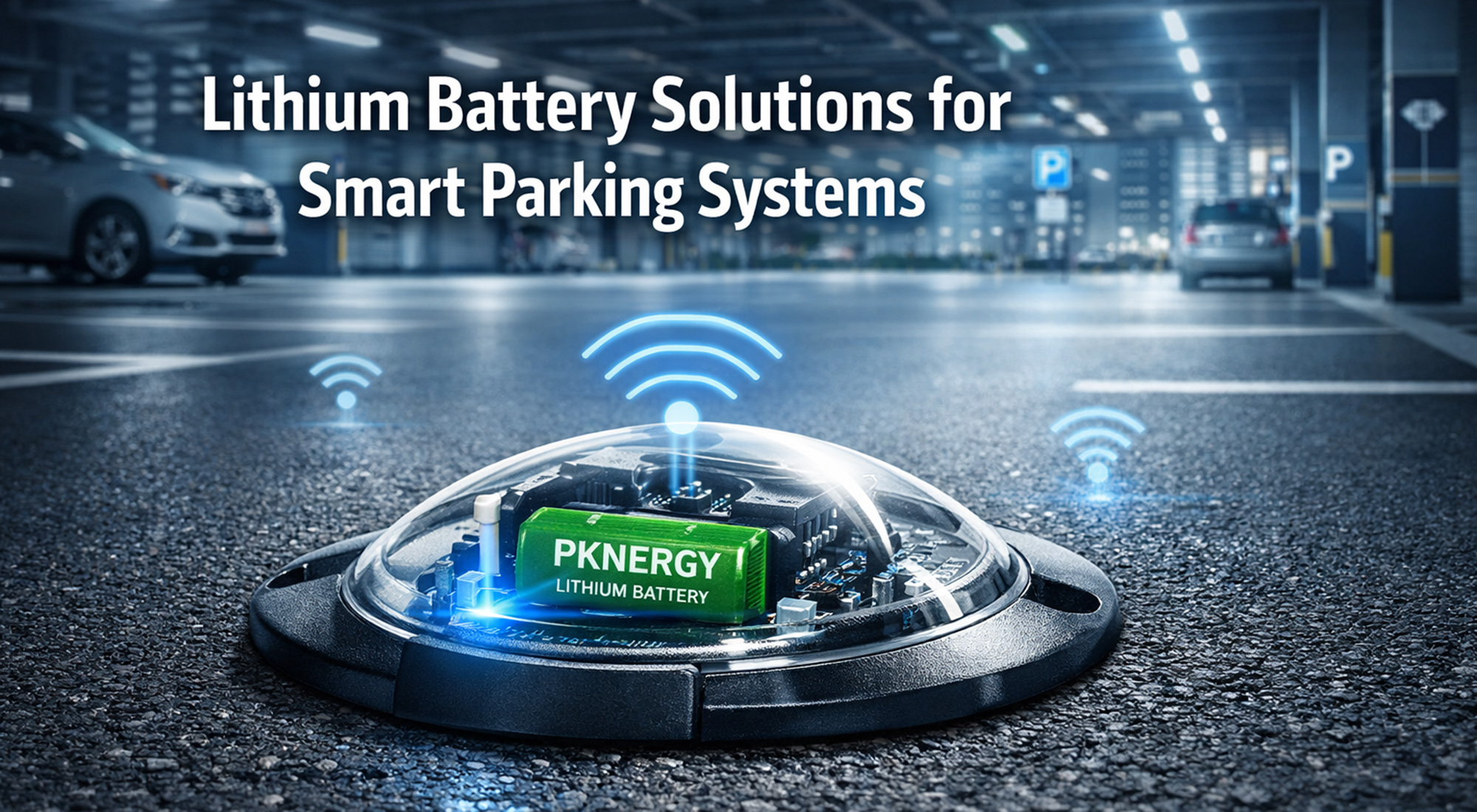
Lithium Battery Applications in Parking Space Detection Systems
Reliable lithium battery solutions powering long-life smart parking detectors and urban IoT infrastructure.
Introduction
Smart parking systems are rapidly transforming urban infrastructure. Parking space detectors play a critical role by delivering real-time occupancy data, improving traffic efficiency and user experience.
At the core of these detectors is a dependable power source. For modern smart city deployments, lithium batteries have become the industry standard due to their stability, energy density, and long service life.
Power Requirements of Parking Space Detectors
Parking space detection devices are usually installed outdoors and expected to operate autonomously for years.
Their power systems must support long-term standby, ultra-low power consumption, and stable voltage output for sensors and wireless modules.
- Continuous operation in outdoor environments
- Low-power sensing with periodic wireless transmission
- Long service life with minimal maintenance
- Stable performance across temperature variations
Frequent battery replacement is impractical and costly, especially in large-scale smart parking or
industrial automation battery systems.
Why Lithium Batteries Are the Preferred Choice
Lithium-based batteries offer multiple advantages that align perfectly with IoT-powered parking detection systems:
- High energy density enabling compact device design
- Low self-discharge for extended standby periods
- Excellent cycle performance for repeated sensing and communication
- Reliable voltage output for wireless and sensing modules
Compared with traditional primary batteries, lithium solutions significantly reduce maintenance frequency and lifetime operating costs in
consumer electronics
and smart city deployments.
Typical Battery Configurations
Battery configuration depends on enclosure size, communication frequency, and expected service life.
Common solutions include:
- Single-cell lithium-ion batteries for moderate energy requirements
- Lithium polymer batteries for ultra-compact and space-constrained designs
Custom lithium battery packs
matched to specific sensing and transmission duty cycles
In many projects, PKNERGY supports clients with
custom battery solutions
optimized for multi-year operation.
PKNERGY’s Approach to Smart Infrastructure Batteries
PKNERGY provides lithium battery solutions specifically engineered for low-power IoT and smart infrastructure applications.
Our batteries are widely used in parking sensors, environmental monitors, and
security device power solutions
.
- Multi-year operation without battery replacement
- Seamless integration with wireless communication modules
- Stable performance throughout the entire lifecycle
Our engineering team assists customers in evaluating real-world power consumption and selecting the most cost-effective
battery configuration
for each project.
FAQ
How long can a lithium battery power a parking space detector?
Depending on sensing frequency and communication intervals, a well-designed lithium battery can support parking detectors
for 3–7 years without replacement.
Are lithium polymer batteries suitable for outdoor parking sensors?
Yes. With proper enclosure design and protection, lithium polymer batteries are widely used in outdoor IoT devices,
especially where compact size is required.
Can PKNERGY provide customized batteries for parking systems?
Absolutely. PKNERGY specializes in
customized lithium battery solutions
tailored to specific voltage, capacity, and lifecycle requirements.
Contact Cassie — PKNERGY
Looking for a reliable lithium battery solution for smart parking or IoT infrastructure?
Our team is ready to support your project.
Post time: Dec-18-2025