
Client Cases: LP8543126 10800mAh 3.4V High-Discharge Li-Po Cell for Power Equipment & Drone High-Load Scenarios

Customer Case Study
Ultra-Low IR · High Discharge
Power / Drone
Model: LP8543126 · 3.4V · 10800mAh · 50A

3.4V 10.8Ah High-Discharge Li-Po Cell for Power Equipment & Drone High-Load Scenarios

A customer developing high-load power equipment and drone-related systems required a lithium polymer solution with
very low internal resistance and high continuous discharge to avoid voltage drop under peak demand.
PKNERGY delivered the LP8543126 cell (3.4V 10800mAh), validated for 50A continuous discharge with
controlled IR and clear temperature usage guidance to support stable performance and production consistency.

Nominal Voltage
3.4V
Capacity
10800mAh
Max Continuous Discharge
50A
Internal Resistance
≤ 5mΩ
Project highlight: The primary requirement was stable output under high current draw.
We focused on low IR screening, discharge stability, and clear operating temperature guidance for real-world deployment.

Application Photo
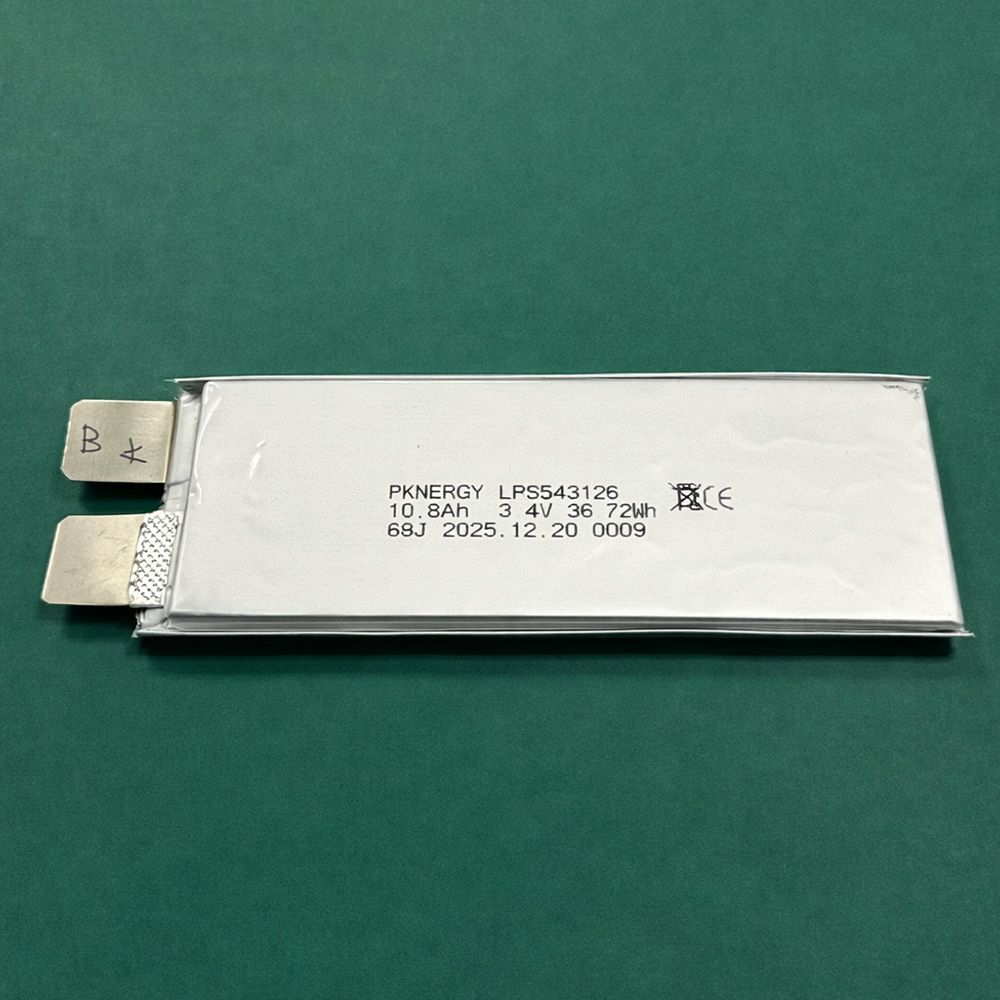
Battery Photo
At a glance
50A continuous output
≤ 5mΩ low IR
Stable under load
Production screening

Introducing the Customer (Anonymous) & Their Journey

The customer is a system integrator working on high-power lithium solutions for power equipment and drone-related platforms.
Due to confidentiality, we do not disclose the company name. For this case study, the project contact is described as a realistic anonymous profile.

Project Contact
Daniel Kim
R&D Engineer, Power Systems
Country / Region
South Korea (Industrial R&D)
Frequent high-load validation tests
Typical Use Case
High-current power modules for drone equipment and portable power devices requiring stable output under heavy load.
Operating Temperature (Field)
Discharge: -20°C to 60°C (best performance 10°C to 35°C)
Charge: 10°C to 35°C (recommended)
Customer’s goal: achieve stable, repeatable high-current output with low voltage drop for demanding applications,
while maintaining clear safety margins and production-ready consistency.

Customer environment / device context (optional)

Challenges (What was going wrong)

1) Voltage drop under heavy load
High current demand can cause significant voltage sag if internal resistance is not well controlled.
This may reduce thrust/torque output and can trigger system protection.
2) Thermal stress & safety margins
Sustained high discharge can increase heat. The customer needed a solution with clear operating limits and validation
to support safe, repeatable performance.
3) Consistency for production
For high-power systems, batch variation in IR and capacity directly impacts performance.
The customer required stable supply quality and screening criteria.
Engineering note
In high-discharge applications, IR control is a key predictor of load stability.
We recommend validating voltage behavior under peak load and setting QC limits to reduce field variation.

The solution emphasized ultra-low IR control, stable discharge behavior, and clear charging/discharging limits to support
both engineering validation and future production supply.

Low IR Screening
Tight internal resistance control (≤ 5mΩ) to improve load stability and reduce voltage sag.
High Discharge Capability
50A continuous discharge supports high load output while maintaining predictable voltage behavior.
Defined Voltage Window
Charging cut-off 4.2V and discharge cut-off 2.7V for stable system control behavior.
Production Consistency
QC checkpoints and batch verification to reduce variation in high-power deployments.

Technical Specifications

Parameter Value
Model LP8543126
Nominal Voltage 3.4V
Nominal Capacity 10800mAh
Size 8.5 × 43.5 × 126.5 mm
Internal Resistance ≤ 5mΩ
Charging Cut-off Voltage 4.2V
Discharge Cut-off Voltage 2.7V
Maximum Constant Charging Current 5A
Maximum Continuous Discharging Current 50A
Cycle Life ≥ 300 cycles (80% DOD)
Weight 190g
Temperature Guidance (Project Reference)
Charge Temperature: 0–10°C (0.2C) · 10–35°C (5A) · 35–45°C (0.2C)
Discharge Temperature: -20–0°C (0.2C) · 0–10°C (0.5C) · 10–35°C (50A) · 35–60°C (0.5C)

Results & Customer Feedback

  • Reduced voltage sag: low IR cell behavior improved stability under high discharge.
  • Higher peak-load confidence: stable output supported demanding power scenarios.
  • Clear operating window: temperature and cut-off guidance reduced misuse risk.
  • Batch consistency: screening targets supported repeatability for future supply.
“We needed a Li-Po cell that could deliver high current with minimal voltage drop. PKNERGY’s low-IR solution helped us
stabilize performance during high-load tests, and the technical guidance made integration much easier.”
— Daniel Kim, R&D Engineer (South Korea) (Anonymous profile)

Photo Gallery (Optional)

Replace each image URL with your WordPress Media Library link. Duplicate or remove cards freely.

Caption: cell appearance & marking.
Caption: tabs / insulation detail.
Caption: application scene.

FAQ — Common Questions

Q1: Why is internal resistance (IR) so important for high-discharge applications?
Lower IR reduces voltage drop under load and improves power stability. For high-current systems, IR control is often a key predictor of
real-world performance consistency.
Q2: What information do you need to recommend the right high-power cell or pack?
Provide your voltage range, peak/continuous current, duty cycle, size constraints, thermal conditions, and system protection limits.
If you have load curves or peak current waveform, we can validate faster.
Q3: Can you support production consistency for high-discharge projects?
Yes. We define QC checkpoints (IR distribution, capacity verification, voltage thresholds, and appearance checks) and align them with your
application risk points to keep performance stable across batches.
Q4: Do you offer custom packs based on this cell?
Yes. We can build multi-series/multi-parallel packs, add protection (PCM/BMS), customize tabs, harness/connector, and validate mechanical fit
depending on your application.

Need a high-discharge lithium solution?
Share your current requirement, duty cycle, size limits, and operating temperature range.
Our engineers will propose a production-ready cell/pack solution.

Post time: Jan-06-2026

Customize samples immediately