
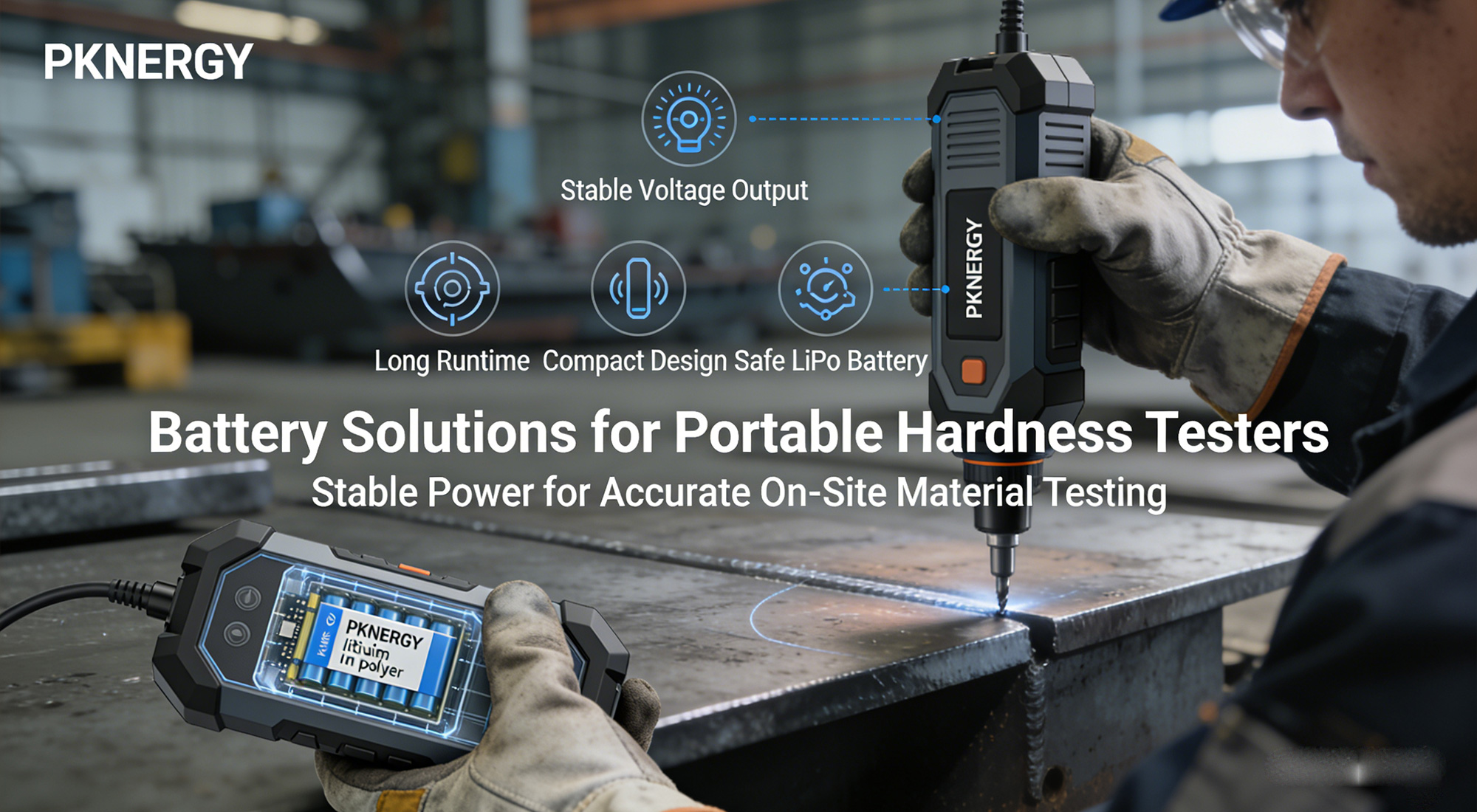
Battery Solutions for Portable Hardness Testers
Stable Power, Long Runtime, and Safe LiPo Packs for On-Site Material Testing
Industrial Testing · Portable Instruments · Custom LiPo Battery
Why Portable Hardness Testers Matter
In modern industrial quality control, engineers can’t always wait for lab results. Portable hardness testers enable on-site hardness measurements of steel, alloys, and heat-treated parts—helping teams prevent failures, ensure compliance, and maintain safety without transporting bulky samples.
But to keep measurement reliable in the field, the power system must be stable—especially the battery.
The Hidden Core: Why the Battery Impacts Accuracy
Although a hardness tester looks simple, the internal sensor system is sensitive to power quality. Even small voltage fluctuations may affect measurement repeatability. At the same time, field inspectors expect a tool that is lightweight, durable, and ready for long working hours.
That’s why many OEMs choose compact Li-polymer (LiPo) battery packs to balance size and endurance.
Key Battery Requirements
- Stable power output: supports repeatable and accurate hardness readings
- Compact form factor: slim and lightweight for truly portable operation
- Extended runtime: often 6–8 hours for a full shift of testing
- Safety & durability: protection against over-charge, over-discharge, short-circuit, and thermal events
- Wide-temperature reliability: performance stability for outdoor or harsh industrial sites
For many handheld testers, an 800–1500mAh LiPo pack is a practical range—compact enough for slim housings while still delivering working-day endurance.
PKNERGY Tailored LiPo Solutions for Portable Hardness Testers
1) Precision-Optimized LiPo Packs
- Capacity range: 800–1500mAh
- Ultra-thin and compact cells to fit slim instrument housings
- Stable discharge curve to support sensor accuracy during extended use
If your device structure is unique, we can also support geometry customization via our customized battery and OEM/ODM service.
2) Industrial-Grade Safety
- Protection circuits for over-voltage, over-current, short-circuit, and thermal events
- Designed for demanding field conditions (optional –20°C to +60°C operating window)
- Compliance-ready designs to support international shipping and product launch timelines
3) Long Service Life
- Typical 500–800 cycles under normal usage
- Reduced downtime and replacement costs for manufacturers and end users
4) Seamless Integration for OEMs
- Customizable dimensions, wiring, and connectors (JST / FPC / wire-to-board)
- Fast prototyping + small-batch sampling for R&D validation
- Production-ready consistency for scale manufacturing
For other handheld field tools, you may also like our article about outdoor power and fast-charging packs: Type-C lithium batteries for outdoor field equipment.
Real-World Field Scenario
Imagine an inspector in a shipyard verifying the hardness of welded joints on-site. With dozens of test points, the instrument must operate reliably throughout the day—without sudden shutdowns or measurement drift.
A well-designed battery pack helps ensure:
- Consistent output for precise readings
- Lightweight handling during hours of fieldwork
- Quick recharging during breaks
- Safe operation even in outdoor conditions
This reliability isn’t just convenient—it can prevent delays, rework, or safety risks.
Beyond Hardness Testers
The same battery challenges apply across many portable testing instruments, such as:
- Ultrasonic thickness gauges
- Coating thickness meters
- Portable thermal cameras
- Handheld environmental analyzers
If you’re building portable inspection tools, start with our custom battery packs manufacturer page to review options and typical integration paths.
FAQ
What capacity is common for portable hardness testers?
Many portable hardness testers use LiPo battery packs in the 800–1500mAh range, balancing slim size with practical runtime.
Why does voltage stability matter for hardness measurement accuracy?
Sensor systems can be sensitive to power ripple or voltage drop. A stable discharge curve helps keep readings repeatable during long field sessions.
Can PKNERGY customize connectors and wiring for my device housing?
Yes. We support connector and harness customization (e.g., JST, FPC, wire-to-board) and can adapt pack dimensions for slim housings.
Do you support prototyping and small-batch sampling?
Yes. We can provide rapid prototypes for validation and then scale to stable mass production after design confirmation.
Contact Cassie — PKNERGY
Developing portable testing instruments (hardness testers, thickness gauges, thermal cameras, analyzers)? Tell us your power profile and mechanical constraints—we’ll propose a safe, stable, production-ready battery solution.
Email: sale4@pknergy.com
Post time: Feb-03-2026